Abstract
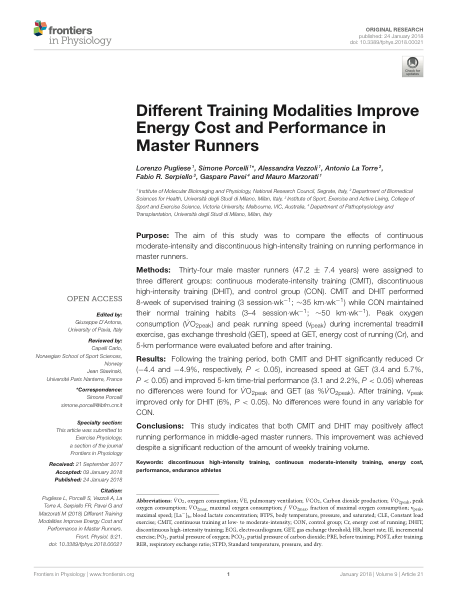
Purpose: The aim of this study was to compare the effects of continuous moderate-intensity and discontinuous high-intensity training on running performance in master runners.
Methods: Thirty-four male master runners (47.2 ± 7.4 years) were assigned to three different groups: continuous moderate-intensity training (CMIT), discontinuous high-intensity training (DHIT), and control group (CON). CMIT and DHIT performed 8-week of supervised training (3 session·wk−1; ~35 km·wk−1) while CON maintained their normal training habits (3–4 session·wk−1; ~50 km·wk−1). Peak oxygen consumption (O2peak) and peak running speed (vpeak) during incremental treadmill exercise, gas exchange threshold (GET), speed at GET, energy cost of running (Cr), and 5-km performance were evaluated before and after training.
Results: Following the training period, both CMIT and DHIT significantly reduced Cr (−4.4 and −4.9%, respectively, P < 0.05), increased speed at GET (3.4 and 5.7%, P < 0.05) and improved 5-km time-trial performance (3.1 and 2.2%, P < 0.05) whereas no differences were found for O2peak and GET (as %O2peak). After training, vpeak improved only for DHIT (6%, P < 0.05). No differences were found in any variable for CON.
Conclusions: This study indicates that both CMIT and DHIT may positively affect running performance in middle-aged master runners. This improvement was achieved despite a significant reduction of the amount of weekly training volume.
Description
This study compares the effects of different training modalities on performance in master runners.