Abstract
Purpose
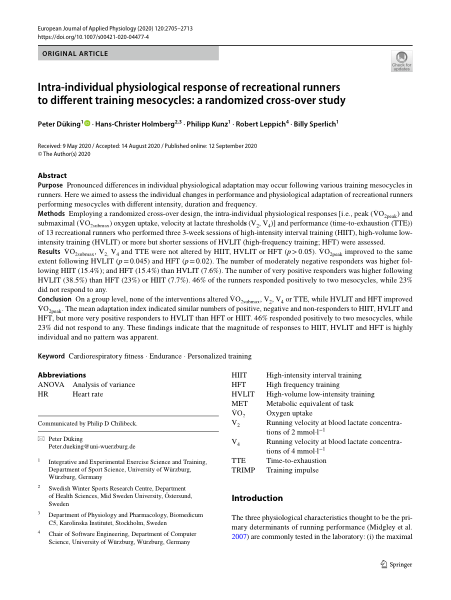
Pronounced differences in individual physiological adaptation may occur following various training mesocycles in runners. Here we aimed to assess the individual changes in performance and physiological adaptation of recreational runners performing mesocycles with different intensity, duration and frequency.
Methods
Employing a randomized cross-over design, the intra-individual physiological responses [i.e., peak (\({\dot{\text V}}{\text O}_{2 {\rm peak}}\)) and submaximal (\({\dot{\text V}}{\text O}_{2 {\rm submax}}\)) oxygen uptake, velocity at lactate thresholds (V2, V4)] and performance (time-to-exhaustion (TTE)) of 13 recreational runners who performed three 3-week sessions of high-intensity interval training (HIIT), high-volume low-intensity training (HVLIT) or more but shorter sessions of HVLIT (high-frequency training; HFT) were assessed.
Results
\({\dot{\text V}}{\text O}_{2 {\rm submax}}\), V2, V4 and TTE were not altered by HIIT, HVLIT or HFT (p > 0.05). \({\dot{\text V}}{\text O}_{2 {\rm peak}}\) improved to the same extent following HVLIT (p = 0.045) and HFT (p = 0.02). The number of moderately negative responders was higher following HIIT (15.4%); and HFT (15.4%) than HVLIT (7.6%). The number of very positive responders was higher following HVLIT (38.5%) than HFT (23%) or HIIT (7.7%). 46% of the runners responded positively to two mesocycles, while 23% did not respond to any.
Conclusion
On a group level, none of the interventions altered \({\dot{\text V}}{\text O}_{2 {\rm submax}}\), V2, V4 or TTE, while HVLIT and HFT improved \({\dot{\text V}}{\text O}_{2 {\rm peak}}\). The mean adaptation index indicated similar numbers of positive, negative and non-responders to HIIT, HVLIT and HFT, but more very positive responders to HVLIT than HFT or HIIT. 46% responded positively to two mesocycles, while 23% did not respond to any. These findings indicate that the magnitude of responses to HIIT, HVLIT and HFT is highly individual and no pattern was apparent.
Description
This study assesses individual changes in performance and physiological adaptation of recreational runners.