Abstract
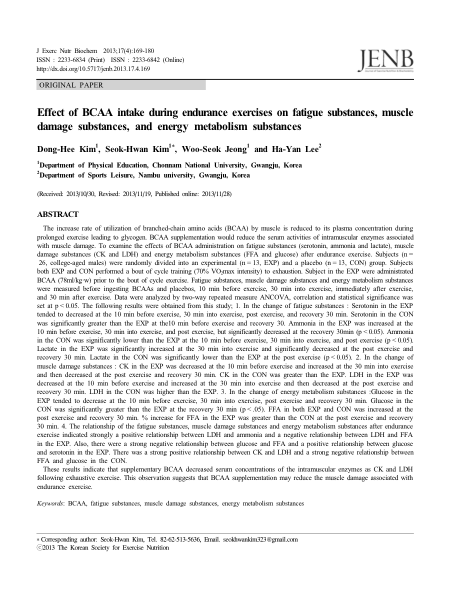
e increase rate of utilization of branched-chain amino acids (BCAA) by muscle is reduced to its plasma concentration during prolonged exercise leading to glycogen. BCAA supplementation would reduce the serum activities of intramuscular enzymes associated with muscle damage. To examine the effects of BCAA administration on fatigue substances (serotonin, ammonia and lactate), muscle damage substances (CK and LDH) and energy metabolism substances (FFA and glucose) after endurance exercise. Subjects (n= 26, college-aged males) were randomly divided into an experimental (n=13, EXP) and a placebo (n=13, CON) group. Subjects both EXP and CON performed a bout of cycle training (70% VO2max intensity) to exhaustion. Subject in the EXP were administrated BCAA (78ml/kg·w) prior to the bout of cycle exercise. Fatigue substances, muscle damage substances and energy metabolism substances were measured before ingesting BCAAs and placebos, 10 min before exercise, 30 min into exercise, immediately after exercise, and 30 min after exercise. Data were analyzed by two-way repeated measure ANCOVA, correlation and statistical significance was set at p<0.05. The following results were obtained from this study; 1. In the change of fatigue substances : Serotonin in the EXP tended to decreased at the 10 min before exercise, 30 min into exercise, post exercise, and recovery 30 min. Serotonin in the CON was significantly greater than the EXP at the10 min before exercise and recovery 30. Ammonia in the EXP was increased at the 10 min before exercise, 30 min into exercise, and post exercise, but significantly decreased at the recovery 30min (p<0.05). Ammonia in the CON was significantly lower than the EXP at the 10 min before exercise, 30 min into exercise, and post exercise (p<0.05). Lactate in the EXP
before exercise and recovery 30. Ammonia in the EXP was increased at the 10 min before exercise, 30 min into exercise, and post exercise, but significantly decreased at the recovery 30min (p<0.05). Ammonia in the CON was significantly lower than the EXP at the 10 min before exercise, 30 min into exercise, and post exercise (p<0.05). Lactate in the EXP was significantly increased at the 30 min into exercise and significantly decreased at the post exercise and recovery 30 min. Lactate in the CON was significantly lower than the EXP at the post exercise (p<0.05). 2. In the change of muscle damage substances : CK in the EXP was decreased at the 10 min before exercise and increased at the 30 min into exercise and then decreased at the post exercise and recovery 30 min. CK in the CON was greater than the EXP. LDH in the EXP was decreased at the 10 min before exercise and increased at the 30 min into exercise and then decreased at the post exercise and recovery 30 min. LDH in the CON was higher than the EXP. 3. In the change of energy metabolism substances :Glucose in the EXP tended to decrease at the 10 min before exercise, 30 min into exercise, post exercise and recovery 30 min. Glucose in the CON was significantly greater than the EXP at the recovery 30 min (p<.05). FFA in both EXP and CON was increased at the post exercise and recovery 30 min. % increase for FFA in the EXP was greater than the CON at the post exercise and recovery 30 min. 4. The relationship of the fatigue substances, muscle damage substances and energy metabolism substances after endurance exercise indicated strongly a positive relationship between LDH and ammonia and a negative relationship between LDH and FFA in the EXP. Also, there were a strong negative relationship between glucose and FFA and a positive relationship between glucose and serotonin in the EXP. There was a strong positive relationship between CK and LDH and a strong negative relationship between FFA and glucose in the CON. These results
LDH and ammonia and a negative relationship between LDH and FFA in the EXP. Also, there were a strong negative relationship between glucose and FFA and a positive relationship between glucose and serotonin in the EXP. There was a strong positive relationship between CK and LDH and a strong negative relationship between FFA and glucose in the CON. These results indicate that supplementary BCAA decreased serum concentrations of the intramuscular enzymes as CK and LDH following exhaustive exercise. This observation suggests that BCAA supplementation may reduce the muscle damage associated with endurance exercise. Keywords: BCAA, fatigue substances, muscle damage substances, energy metabolism substances
170 BCAA intake during endurance exercise Item group Age (yrs) Height (cm) Weight (kg) Rest Heart rate (beat)BMI (kg/m 2 ) Experimental group (n=13) 23.72±2.34 171.69±3.86 67.42±8.56 65.01±5.25 22.93±4.28 Placebo group (n=13) 22.45±2.46 168.17±3.39 66.21±7.93 64.14±7.06 23.40±5.36 Values are Means±SD. Table 1. Physical characteristics of subjects INTRODUCTION Recently, ordinary people as well as athletes consume more and diverse ergogenic aids to improve density of skeletal muscle and exercise performance [2]. As prolonged exercise depletes carbohydrate and mobilizes fat as an energy source, fat acts as an important energy substrate for muscle function [3]. In order to improve exercise performance, carbohydrates and amino acids which are the source of protein, especially BCAA (Branched Chain Amino Acid; BCAA) are critical. Amino acids help enhance metabolism which promotes cell proliferation and improve exercise performance as well as functional recovery during exercise [18,8]. Also, they help perform better by contributing as the energy source and reducing the accumulation of 5-HT (serotonin), the central fatigue substance. Blood CK (creatine kinase; CK) concen- tration and blood LDH (lactate dehydrogenase; LDH) concentration are the indicators that reflect the degree of muscle damage and physical fitness from long-term physical activity [19]. CK is the main enzyme that controls the ATP-PC system and LDH is the main enzyme that maintains the balance of sugar catabolism and anabolism. Coombes and McNaughton[4]. reported that CK and LDH concentrations had decreased after they exercised on a bicycle ergometer with an intensity of 70 percent of their maximal oxygen uptake for a long period of time after following a common diet and taking 64mg of BCAA in proportion to body weight. Greer[7]. reported that those who exercise on a bicycle ergometer with an intensity of 50 percent of their maximal oxygen uptake after taking BCAA showed a lower increase in CK and LDH concentrations compared with people in the placebo group. Free fat acid (FFA), which is released from the adipose tissue and produces energy, is a major source of energy during exercise that requires long-term endurance. The amount of FFA during exercise or after exercise is totally affected by glycerol. Muscle capillaries
taking BCAA showed a lower increase in CK and LDH concentrations compared with people in the placebo group. Free fat acid (FFA), which is released from the adipose tissue and produces energy, is a major source of energy during exercise that requires long-term endurance. The amount of FFA during exercise or after exercise is totally affected by glycerol. Muscle capillaries are extended at the beginning of exercise to promote the use of FFA and this metabolic phenomenon ends at the end of the exercise. Glucose functions a basic role in carbohydrate metabolism of skeletal muscle and is generated from muscle glycogen and blood. In particular, glucose produced from the liver during exercise with intensity of about 60 percent of maximal oxygen uptake starts to decrease around 90 minutes after the exercise begins and glycogen stored in the liver is mobilized. However, when BCAA is ingested, the BCAA moves to the muscle and is oxidized to supply additional energy. As a result, the amount of glucose that is decomposed in the liver and released into the blood is reduced and accordingly, the level of glucose in the blood is decreased. It was reported that the intake of BCAA helped to prevent physical performance from deteriorating, which is usually caused by muscle glycogen depletion in the later stages of endurance exercises [3]. However, there is no enough research for the BCAA dosage depending on forms of exercise, as well as changes in fatigue substances, muscle damage substances, and energy meta- bolism substances. Thus, this study was conducted not only to analyze how the intake of BCAA during endurance exercise affects fatigue substances, muscle damage substances, and energy metabolism substances but also to identify interrelated factors. RESEARCH METHOD Research subjects In this study, 30 male subjects were primarily selected from student volunteers attending J University. The 30 subjects then had to undergo a physical examination to determine whether they had metabolic anomalies, cardiovascular anomalies, or any disorder associated with muscle as well as to ascertain whether they had ever used muscle enhancers. Students who were found to have diseases or to have taken
30 male subjects were primarily selected from student volunteers attending J University. The 30 subjects then had to undergo a physical examination to determine whether they had metabolic anomalies, cardiovascular anomalies, or any disorder associated with muscle as well as to ascertain whether they had ever used muscle enhancers. Students who were found to have diseases or to have taken muscle enhancers were excluded from the experiment. Before entering this experiment, the height, the weight, and the makeup of the subjects were measured to select the final 26 through the process to minimize errors. This was to minimize potential physical differences among the individual subjects in the clinical trial. All the process also received approval by the ethics committee. Thirteen participants were randomly assigned to the BCAA intake group and the others were assigned to the placebo group. All the subjects were educated to understand the behavior that could affect the experiment and submitted the experimental agreement. Physical characteristics of the subjects are shown in the <Table 1>.
Dong-Hee Kim et al./J Exerc Nutr Biochem 17(4):169-180, 2013 171 Experimental design In this study, the subjects rode on the bicycle ergometer (Corival, Monark Inc., USA) and started gradual maximum exercise after having taken BCAAs, which was dissolved in bottled water, and having drunken placebos (bottled water). Dependent variables were measured five times; before ingesting BCAAs and placebos; 10 minutes before exercise; 30 minutes into exercise; immediately after exercise; 30 minutes after exercise. Then the impact of the variables, which are related to fatigue substances, muscle damage substances, and energy metabolism substances, was analyzed. Preliminary experiments were conducted to all the subjects one week before the experiment. Drinking, smoking, and caffeine intake were banned three days before the experiment. All of the research was conducted at the same time every day in order to minimize the effects of variables including the experimental time, conditions, and the subjects’ circadian rhythm. Before the experiment, the researchers randomly determined the order in advance and proceeded with every experiment in that order. BCAAs and placebos were taken in accordance with a double-blind trial. The experiment was performed with an interval of one week to minimize the effects of previous exercise. Experimental procedure and method Exercise Method Subjects fasted on the day of the experiment and got plenty of rest three hours before exercise. A week before the experiment, each individual subject’s maximal exercise capacity (maximal oxygen uptake, VO2max) was measured. The Astrand-Rhyming protocol (1965) was used . The first starting load was 600 kg·m/min (50 rpm, 2 kp; 100 w) and the load was increased by 300 kg·m/min (50 w) every two minutes. For endurance test, the subjects started exercise with an intensity of 1 kp (50 w, 50 rpm) and the intensity was increased by 2 kp (100 w, 50 rpm) five minutes later. Ten minutes later, the intensity (kp) was increased to 70 percent of individual maximal oxygen uptake (VO2max) and continued until the person could not work out any longer. Each individual’s point of exhaustion was determined as follows: when the subjects themselves said that they could not continue exercising at
increased by 2 kp (100 w, 50 rpm) five minutes later. Ten minutes later, the intensity (kp) was increased to 70 percent of individual maximal oxygen uptake (VO2max) and continued until the person could not work out any longer. Each individual’s point of exhaustion was determined as follows: when the subjects themselves said that they could not continue exercising at the intensity corresponding to the 19 th level of the Borg Scale (1982): when they were not able to maintain 50 rpm on the bicycle ergometer for five seconds or longer: their heart rates were greater than the maximum heart rate (220-age) minus 10bpm (Heyward, 2010). During the experiment, an average temperature of 20-24℃ was maintained in the laboratory and an average, relative humidity of 40-60% was maintained. BCAA ingestion BCAA containing isoleucine (20%), valine (24%), and leucine (46%) was dissolved in 500 ml of reverse osmosis water and 80 mg/kg (Lee Han and others, 2002; Shimomura, et al., 2010) BCAA of weight was administered. The subjects drank reverse osmosis water as the placebos. Aspantam (15 mg/100 ml of reverse osmosis water) was added to both the BCAA and the placebo so that the subjects could not distinguish taste. As the double blind crossover method was used, neither the subjects nor the researchers were able to know which liquid was the BCAA or the placebo. The subjects arrived at the laboratory in a fasting state and lied down to rest for 30 minutes. Then they drank 500 ml of BCAAs or placebos 50 minutes before exercise in accordance with studies (Leibetseder, et al., 2006) suggesting any longer than this result in the bodily elimination of the BCAAs. Taking blood samples The subjects rested 48 hours before the experiment and fasted 12 hours before the experiment. They were asked to arrive at the laboratory three hours before the experiment to measure their heights and weights. This was followed by a 30-minute rest. Catheters were inserted into the veins in the cubital fossas of the subjects who wore Polar (FIN-90440, Filand) watches. The experiment started 50 minutes after the subjects took BCAAs
12 hours before the experiment. They were asked to arrive at the laboratory three hours before the experiment to measure their heights and weights. This was followed by a 30-minute rest. Catheters were inserted into the veins in the cubital fossas of the subjects who wore Polar (FIN-90440, Filand) watches. The experiment started 50 minutes after the subjects took BCAAs or placebos. Ten milliliters of blood was taken from the veins in the cubital fossa using a disposable syringe five times; before ingesting BCAAs or placebos; 10 minutes before exercise; 30 minutes into exercise; immediately after exercise; 30 minutes after exercise. The analysis was conducted by The Clinical Pathology Center of J University. Test items and methods The test methods to analyze fatigue substances include a specific vehicle of EDTA-2Na with 8% Hypochlorite acid4 (HCIO4), 1% EDTA and 1% Ascorbic acid as a phosphorous acid at a pH of 3.5 in order to remove protein in Serotonin (5-HT). The study collected blood samples to agitate them in the centrifuge (HANIL Centrifuge MF_80) at a rate of 12,000 rpm for 20 minutes, and moved only the necessary amounts of them to the sample injection tube to measure them based on a L-8200 type of HPL (high performance liquid chromatography). To measure ammonia, this study used a spectrophotometer (CL-750) to observe Berthelot responses, and employed the spectrophotometer to measure lactate in the blood based on an enzyme method. To analyze CK, a muscle damage substance, the study used vacuum tubes for blood
172 BCAA intake during endurance exercise Item GroupBerore ingesting 10 min before exercise a 30 min into exercise b Immediately after exercise c 30 min after exercise d F Pr>F post-hoc serotonin (µg/dl) EG 16.00 21.87 8.63 7.25 7.02 4.27 7.80 4.15 3.77 3.81 3.424 .324 - MV±SE 8.62 6.43 7.04 1.22 7.80 1.01 3.75 1.21 PG 15.77 8.52 19.93 30.02 9.45 6.22 12.40 2.54 10.95 5.81 4.104 .278 - MV±SE 19.95 6.43 9.43 1.22 12.40 1.01 10.97 1.21 ammonia (umol/L) EG 241.17 57.64 212.50 35.98 268.50 42.42 301.67 72.48 179.67 56.56 9.09 .0001 A:C B,C:D MV±SE 217.41 6.93 275.25 11.12 304.08 18.18 182.36 12.12 PG 269.00 113.69 169.00 42.55 218.00 69.41 248.83 52.02 165.67 27.02 5.621 .001 A,B,D:C MV±SE 164.10 6.93 211.25 11.21 246.42 18.18 162.97 12.12 lactate (mmol/L) EG 13.43 8.57 10.60 1.33 47.62 13.42 14.88 2.47 13.18 2.44 54.251 .0001 B:A,C,D MV±SE 10.59 .82 47.39 4.70 14.88 2.77 13.10 .70 PG 9.65 1.79 12.08 3.59 47.92 17.40 31.32 12.67 16.12 2.21 32.026 .0001 A,D:BC MV±SE 12.08 .82 48.14 4.70 31.32 2.77 16.20 .70 EG, experimental group; PG, placebo group. Table 2. The change of fatigue substances by the endurance exercises test to collect blood samples, which were then stirred at rates of 2500-3000 rpm for 15-20 minutes. The necessary amounts of bloods for measurement were once again extracted to analyze them with a dry biochemical analyzer (Kodak EKTACHEM DTSC Ⅱ, USA). To measure LDH, 2.70ml of Trisbuffer (57.5mmol/l), 0.1ml of NADH solution and 0.1ml extracted tissues were mixed evenly in a cuvette with a diameter of 1cm, and were then warmed up in a water at 30℃ for 10-20 minutes. The reactants was added with 0.2ml of pyruvate solution and evenly stirred before being measured with the dry bio-chemical analyzer (Kodak EKTACHEM DTSC Ⅱ) equipped with a heating device at a rate of 340nm at intervals of half or 1 minute for 3-6 minutes. To determine FFA, the study an energy metabolism substance, the study collected blood samples with the vacuum tube equipped with a clot activator designed to precipitate fibrinogen, agitated them in a centrifuge at
dry bio-chemical analyzer (Kodak EKTACHEM DTSC Ⅱ) equipped with a heating device at a rate of 340nm at intervals of half or 1 minute for 3-6 minutes. To determine FFA, the study an energy metabolism substance, the study collected blood samples with the vacuum tube equipped with a clot activator designed to precipitate fibrinogen, agitated them in a centrifuge at rates of 2,500-3,000 rpm for 15-20 minutes, added 50 µl STD solution to 0.5 ml extracted blood serums to mix them a SICDIA NEFAZYME test reagent, and finally used Hitachi 7150 (Hitachi, Japan) to measure FFA after putting them in a cold water for 5 minutes. To measure glucose, the study agitated the collected blood samples in a centrifuge at rates of 2,500-3,000 rpm for 15-20 minutes and analyzed the supernatant liquid with a dry bio chemical analyzer (Kodak EKTACHEM DTSC Ⅱ, USA). Data processing The study measured the mean and standard deviation of each variable by using the SPSS (ver 17.0). The study conducted the repeated ANCOVA with ‘before the intake of BCAA’ set up as a common variant to verify mean differences between groups and times. After having verified the gradients of the data prior to the test, the study found that the gradients of the data were all identical. In addition, in case that a significant difference happened, the study carried out a post verification test based on the Duncan method. The analysis on the correlation between the variables within each subject group was done with the Pearson correlation method. STUDY RESULTS Changes in fatigue substances, muscle damage Substances and energy metabolism substances after endurance exercises Changes in Fatigue Substances after Endurance Exercises The serotonin levels in the experimental group showed a tendency of decreasing at 10 min before exercise, 30 min into exercise, immediately after exercise, and until 30 min after exercise, in comparison with those before the intake of
Dong-Hee Kim et al./J Exerc Nutr Biochem 17(4):169-180, 2013 173 Source DF TypeⅢSS Mean Square F-Value Pr>F covariance (pre-administration) 1 11.453 11.453 .090 .767 group 1 978.152 978.152 7.704 .011 error (group) 21 2666.228 126.963 time 3 432.495 144.165 1.037 .383 time×covariance (pre-administration) 3 471.951 157.317 1.131 .343 group×time 3 265.522 88.507 .636 .594 error (time) 63 8761.844 139.077 Table 3. The result of repeated ANCOVA on the change of serotonin between groups and time Source DF TypeⅢSS Mean Square F-Value Pr>F covariance (pre-administration) 1 64832.093 64832.093 16.271 .001 group 1 55227.681 55227.681 13.861 .001 error (group) 21 83673.324 3984.444 time 3 25781.634 8593.878 6.964 .001 time×covariance (pre-administration) 3 11474.725 3824.908 3.100 .033 group×time 3 6983.682 2327.894 1.887 .141 error (time) 63 77739.525 1233.961 Table 4. The result of repeated ANCOVA on the change of ammonia between groups and time Source DF TypeⅢSS Mean Square F-Value Pr>F covariance (pre-administration) 1 6.194 6.194 .065 .802 group 1 645.923 645.923 6.735 .017 error (group) 21 2014.035 95.906 time 3 3822.763 1274.254 14.872 .001 time×covariance (pre-administration) 3 7.203 2.401 .028 .994 group×time 3 893.500 297.833 3.476 0.21 error (time) 63 5397.815 85.68 Table 5. The result of repeated ANCOVA on the change of lactate between groups and time the BCAA, while the ammonia levels tended to be increased at10 min before exercise, 30 min into exercise and immediately after exercise, compared with those before the intake of the BCAA, but showed a statistically significant drop at 30 min after exercise. The lactate levels showed a statistically important increase at 30 min into exercise, compared with those before the intake of the BCAA, but dropped by a statistically important degree at immediately after exercise and 30 min after exercise. A statistically significant difference in the interaction between the subject groups was observed at immediately after exercise. The serotonin levels in the placebo group were decreased at 10 min before exercise and 30 min into exercise compared with those before the intake of the BCAA, while their ammonia levels were increased at 10 min before exercise and 30 min into exercise, in comparison with those
Description
The study examines the effects of BCAA on fatigue and muscle damage during endurance exercise.