Abstract
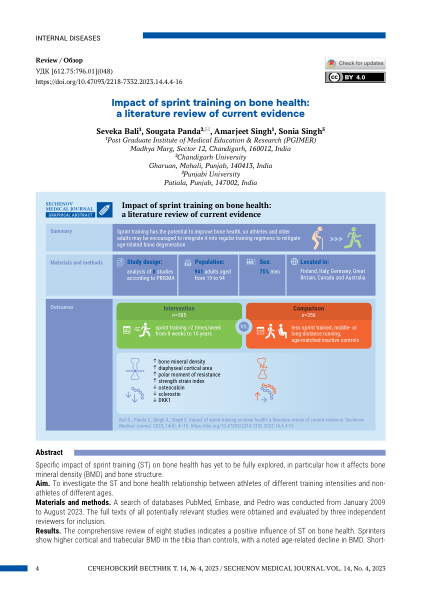
sprint training (ST) on bone health has yet to be fully explored, in particular how it affects bone mineral density (BMD) and bone structure. Aim. To investigate the ST and bone health relationship between athletes of different training intensities and non- athletes of different ages. Materials and methods. A search of databases PubMed, Embase, and Pedro was conducted from January 2009 to August 2023. The full texts of all potentially relevant studies were obtained and evaluated by three independent reviewers for inclusion. Results. The comprehensive review of eight studies indicates a positive influence of ST on bone health. Sprinters show higher cortical and trabecular BMD in the tibia than controls, with a noted age-related decline in BMD. Short- 4.0 Impact of sprint training on bone health: a literatur e review of curr ent evidence Summary Materials and methods Outcomes Bali S., Panda S., Singh A., Singh S. Impact of sprint tr aining on bone health: а liter ature review of curr ent evidence. Secheno v Medical Journal. 2023; 14(4): 4–16. https:/ /doi.or g/10.47093/2218-7332.2023.14.4.4-16 Sprint training has the potential to improve bone health, so athletes and older adults may be encour aged to integr ate it into regular training regimens t o mitigate age-related bone degeneration Study design: Population: Sex: Located in: analysis of 8 studies according to PRISM A 941 adults aged from 19 t o 94 75% men Finland, Italy, Germany, Great Britain, Canada and Australia Intervention n=585 sprint
bone health, so athletes and older adults may be encour aged to integr ate it into regular training regimens t o mitigate age-related bone degeneration Study design: Population: Sex: Located in: analysis of 8 studies according to PRISM A 941 adults aged from 19 t o 94 75% men Finland, Italy, Germany, Great Britain, Canada and Australia Intervention n=585 sprint training >2 times/week from 8 weeks t o 10 years bone mineral density diaphyseal cortical ar ea polar moment of resistance strength str ain index osteocalcin sclerostin DKK1 less sprint tr ained, middle- or long-distance running, age-matched inactive contr ols Comparison n=356 GRAPHICAL ABSTRA CT SECHENOV MEDICAL JOURNAL VS.
СЕЧЕНОВСКИЙ ВЕСТНИК Т. 14, № 4, 2023 / SECHENOV MEDICAL JOURNAL VOL. 14, No. 4, 2023 5 ВНУТРЕННИЕ БОЛЕЗНИ distance runners demonstrate signifi cantly better BMD, counter-movement jump performance, and grip strength compared to long-distance runners. These benefi ts are consistent across various age groups, including older athletes, with minimal age-related changes in mid-tibial BMD. ST is also associated with a 21% increase in tibial stress-strain index, indicating sustained bone strength, and a reduction in fracture risk in the elderly through downregulation of fracture-related microRNAs. Conclusion. ST signifi cantly enhances bone health, particularly in improving BMD and bone microarchitecture. Incorporating ST into exercise routines may benefi t athletes and older individuals. Further research is essential to understand the mechanisms and develop optimal training protocols for bone health. Keywords: athletes; exercise; osteoporosis; bone density; osteopenia; sports MeSH terms: RUNNING EXERCISE BONE AND BONES BONE DENSITY REVIEW For citation: Bali S., Panda S., Singh A., Singh S. Impact of sprint training on bone health: a literature review of current evidence. Sechenov Medical Journal. 2023; 14(4): 4–16. https://doi.org/10.47093/2218- 7332.2023.14.4.4-16 CONTACT INFORMATION: Sougata Panda, Assistant Professor, Department of Physiotherapy, Chandigarh University, Mohali, Punjab, India. Address: Gharuan, Mohali, Punjab, 140413, India Tel.: 08116090083 E-mail: sougataphysio@gmail.com Confl ict of interests. The authors declare that there is no confl ict of interests. Financial support. The study was not sponsored (own resources). Received: 21.08.2023 Accepted: 05.10.2023 Date of publication: 30.11.2023 Влияние спринтерских тренировок на здоровье костей: обзор литературы Севека Бали¹, Сугата Панда² , , Амарджит Сингх¹, Соня Сингх³ ¹Институт последипломного медицинского образования и исследований (PGIMER) Мадхья Марг, сектор 12, Чандигарх, 160012, Индия ²Университет Чандигарх Гаруан, Мохали, Пенджаб, 140413, Индия ³Пенджабский университет Патиала, Пенджаб, 147002, Индия Аннотация Влияние спринтерских тренировок (СT) на здоровье костей изучено недостаточно, в особенности воздей- ствие на минеральную плотность костной ткани (МПК) и структуру костей. Цель. Изучить взаимосвязь СT и здоровья костей среди профессиональных спортсменов, тренирующихся с разной интенсивностью, и спортсменов-любителей разного возраста. Материалы и методы. Поиск по базам данных PubMed, Embase и Pedro проводился с января 2009 по август 2023 г. Были получены полные тексты всех потенциально релевантных исследований и оценены по критери- ям
ствие на минеральную плотность костной ткани (МПК) и структуру костей. Цель. Изучить взаимосвязь СT и здоровья костей среди профессиональных спортсменов, тренирующихся с разной интенсивностью, и спортсменов-любителей разного возраста. Материалы и методы. Поиск по базам данных PubMed, Embase и Pedro проводился с января 2009 по август 2023 г. Были получены полные тексты всех потенциально релевантных исследований и оценены по критери- ям включения тремя независимыми рецензентами. Результаты. Комплексный обзор восьми исследований указывает на положительное влияние СT
Y M _ M U V J Y R P Q J M Y Z U P R Z- 03 8 3 1/12 . RDB +DMN 9 0DC ,B $ / INTQM $ / 9N /- 03 Mn- 3 1/12 6INTERNAL DISEASES на здоровье костей. У спринтеров наблюдается более высокая кортикальная и трабекулярная МПК большеберцовой кости, чем в контрольной группе, с возрастным снижением МПК. Спринтеры демон- стрируют значительно более высокую МПК, лучший результат в тесте прыжка со встречным движением и бóльшую силу хвата по сравнению с бегунами на длинные дистанции. Эти преимущества СТ были вы- явлены в разных возрастных группах, включая спортсменов старшего возраста, у которых возрастные изменения МПК средней части большеберцовой кости были минимальными. СT также связаны с уве- личением на 21% индекса напряжения-деформации большеберцовой кости, что указывает на устойчи- вую прочность костей и снижение риска переломов у пожилых людей за счет подавления микро-РНК, связанных с переломами. Заключение. СT значительно укрепляют здоровье костей, особенно за счет повышения минеральной плотности кости и улучшения микроархитектуры кости. Включение СT в программу физической под- готовки может принести пользу как спортсменам, так и пожилым людям. Дальнейшие исследования необходимы для понимания механизмов и разработки оптимальных для здоровья костей режимов тре- нировок. Ключевые слова: спортсмены; тренировки; остеопороз; плотность костной ткани; остеопения; спорт Рубрики MeSH: БЕГ ФИЗИЧЕСКАЯ НАГРУЗКА КОСТЬ И КОСТНЫЕ ТКАНИ КОСТИ ПЛОТНОСТЬ ОБЗОР Для цитирования: Бали С., Панда С., Сингх А., Сингх С. Влияние спринтерских тренировок на здоро- вье костей: обзор литературы. Сеченовский вестник. 2023; 14(4): 4–16. https://doi.org/10.47093/2218- 7332.2023.14.4.4-16 КОНТАКТНАЯ ИНФОРМАЦИЯ: Панда Сугата, доцент кафедры физиотерапии Университета Чандигарха, Мохали, Пенджаб, Индия. Адрес: Гаруан, Мохали, Пенджаб, 140413, Индия Tel.: 08116090083 E-mail: sougataphysio@gmail.com Конфликт интересов. Авторы заявляют об отсутствии конфликта интересов. Финансирование. Исследование не имело спонсорской поддержки (собственные ресурсы). Поступила: 21.08.2023 Принята: 05.10.2023 Дата печати: 30.11.2023 List of abbreviation: ST – Sprint training SIT – sprint interval training BMD – bone mineral density RST – repeated-sprint training SSI – stress-strain index miRNAs – micro ribonucleic acids pQCT – Peripheral Quantitative Computed Tomography
of abbreviation: ST – Sprint training SIT – sprint interval training BMD – bone mineral density RST – repeated-sprint training SSI – stress-strain index miRNAs – micro ribonucleic acids pQCT – Peripheral Quantitative Computed Tomography
СЕЧЕНОВСКИЙ ВЕСТНИК Т. 14, № 4, 2023 / SECHENOV MEDICAL JOURNAL VOL. 14, No. 4, 2023 7 ВНУТРЕННИЕ БОЛЕЗНИ HIGHLIGHTS КЛЮЧЕВЫЕ ПОЛОЖЕНИЯ Sprint training enhances bone density and structure, notably reducing fracture risks in athletes. Спринтерские тренировки повышают плотность и укрепляют структуру костей, что значительно снижает риск переломов у спортсменов. Benefits of sprint training span all age groups, effectively countering bone aging effects. Преимущества спринтерских тренировок распространяются на все возрастные группы, эффективно противодействуя эф- фектам старения костей. Enhanced bone health results from mechanical stimuli and hormonal influences due to sprint training. Улучшение здоровья костей в результате спринтерских трени- ровок происходит за счет механических воздействий и гормо- нальных влияний. Compared to long-distance athletes and sedentary individuals, sprinters exhibit superior bone health. При сравнении с бегунами на длинные дистанции и людьми, ведущими малоподвижный образ жизни, спринтеры демон- стрируют лучшее здоровье костей. Integral for osteoporosis prevention, sprint training is particularly advantageous for older adults. Включение в комплекс мер по профилактике остеопороза спринтерских тренировок будет особенно полезным для по- жилых людей. Sprint training is crucial in numerous athletic activities, providing a signifi cant competitive benefi t in the majority of sports and frequently determining performance success [1, 2]. It requires fast muscular energy release to move an athlete forward at the highest possible speed [3]. Sprint training (ST) that combines running with resistance exercises provides effective osteogenic stimulus for maintaining bone density, especially in lower limbs [2, 4–11]. According to studies conducted on young and older athletes, sprint and power sports offer an effi cient osteogenic stimulus that strengthens bones [1, 3, 12–14]. Sprint performance has been extensively evaluated using a range of measurements such as peak, mean, and total power, a velocity test or time trial measurement over a set distance [1, 15, 16]. Depending on the phase an athlete or person is in, ST comprises a variety of interventions and exercise intensities [17]. Compared to aerobic training, sprint interval training (SIT) produces only changes in aerobic fi tness and other body composition parameters in premenopausal women [18]. It also helps to improve cardiovascular health in obese people and reduce the infl ammatory
16]. Depending on the phase an athlete or person is in, ST comprises a variety of interventions and exercise intensities [17]. Compared to aerobic training, sprint interval training (SIT) produces only changes in aerobic fi tness and other body composition parameters in premenopausal women [18]. It also helps to improve cardiovascular health in obese people and reduce the infl ammatory process in diabetic patients [19, 20]. The possible preventative role of ST against osteoporosis and bone health must be investigated in depth to determine the signifi cance of the same in preventing these disorders. Regular ST positively affects the density and structure of bone, particularly in older and middle- aged athletes, with direction-specifi c effects on bone health [5, 7]. Sprinting has the potential to promote bone formation through the application of mechanical stress and the upregulation of growth factors. Sprinters may have longer forefoot bones due to increased mechanical stress during sprinting, although further research is required to establish any correlation with sprint performance [21]. The effects of repeated-sprint training (RST) on bone health are currently unknown, but high-impact loading from sprinting has been shown to potentially prevent age-related bone loss [6, 22]. Sprinters have been found to have elevated bone density in the hips and spine compared to endurance athletes and non-athletic control [11]. Over time, power athletes (such as those who specialize in jumping and sprinting) appear to better maintain bone mass compared to endurance athletes, prominently in men and regardless of any changes in performance. However, the moment of inertia for a cross- sectional area does not seem to show the same difference between male and female athletes [23]. The impact of ST on bone health is attributed to a combination of factors, incorporating factors such as exercise intensity and loading, individual body dimensions, and hormonal attributes [5]. In addition, ST can make benefi cial alterations in muscular activity patterns, leading to effi ciency improvements through neural pathways and decreased co-contractions [24]. ST can also increase the activity of the enzyme citrate synthase, which is an indicator of muscle oxidative potential [25]. Although the processes underlying
as exercise intensity and loading, individual body dimensions, and hormonal attributes [5]. In addition, ST can make benefi cial alterations in muscular activity patterns, leading to effi ciency improvements through neural pathways and decreased co-contractions [24]. ST can also increase the activity of the enzyme citrate synthase, which is an indicator of muscle oxidative potential [25]. Although the processes underlying the favorable effects of exercise on skeletal health are not yet entirely known, mechanical stimuli, hormones, cytokines, cell signaling pathways and noncoding RNAs are believed to be contributing factors [26]. Bone responds best to exercise throughout adolescence and reduced physical activity during the later stages of life is a contributing factor to the decline in bone mass commonly associated with aging [27, 28]. Regular strength and ST prevent bone deterioration in adults and provides strong osteogenic stimuli to improve bone characteristics at loaded sites. Stimuli such as compression and fl uid shear are crucial for osteoblastic activity and the maintenance of a healthy bone mass and density [29]. Sprint-trained athletes exhibit observable structural adaptations as a thickened cortical loaded area, which is one of the reasons for effective direction- specifi c bending strength [30].
СЕЧЕНОВСКИЙ ВЕСТНИК Т. 14, № 4, 2023 / SECHENOV MEDICAL JOURNAL VOL. 14, No. 4, 2023 8 INTERNAL DISEASES Hence, the objective of this review is to critically evaluate the current evidence on the impact of sprint training on bone health, including the effects on bone mineral density, bone turnover markers, and fracture risk, to provide a comprehensive analysis of the potential benefi ts and limitations of this training modality for promoting bone health. MATERIAL AND METHODS The methodology for conducting this review was based on the PRISMA 2020 checklist [31]. Eligibility criteria We adhered to the PICOS framework (Population, Intervention, Comparison, Outcomes, and Study) for the design of this study, as described below [32]. Population: Humans of any age, gender, and fi tness level who have undergone sprint training. Intervention: Sprint training is defi ned as a high- intensity exercise protocol that involves short bursts of maximal effort, with or without additional interventions of any duration or frequency. Comparison: Any comparison group, including sedentary individuals, those engaging in other types of physical activity, individuals undergoing no intervention, placebo or any forms of exercise. Outcomes: Bone health, which may be measured using various indicators such as bone mineral density, bone turnover markers or fracture incidence. Study design: Any experimental and observational research designs, such as randomized controlled trials, non-randomized controlled trials, cohort studies, and case-control studies. However, reviews and conference abstracts were excluded from the study. Literature search A systematic literature search was done in electronic databases such as PubMed, Embase, Pedro from January 2009 to August 2023. A variety of keywords like sprinting, exercises, bone health and osteoporosis were used for the same. The details of the search strategy are provided in Table 1. Study selection The studies were initially evaluated individually by all four reviewers (SP) (SB) (SS) (AS). All the studies that fulfi lled the inclusion or eligibility criteria were included. The difference of opinion was settled by communication among the four regarding the same. In this study, a meta-analysis was not conducted due to the heterogeneity found among the included studies. The study fl ow chart
initially evaluated individually by all four reviewers (SP) (SB) (SS) (AS). All the studies that fulfi lled the inclusion or eligibility criteria were included. The difference of opinion was settled by communication among the four regarding the same. In this study, a meta-analysis was not conducted due to the heterogeneity found among the included studies. The study fl ow chart is depicted in Figure. RESULTS There were 416 studies shortlisted from the databases. After eliminating the duplicates, animal studies and studies that were unrelated to the aim, fi ndings were limited to eight studies. The included studies were carried out in Finland, Italy, Germany, United Kingdom, Canada and Australia. The majority of the research relied on computer tomography to assess the density and other properties of bone. D.C. Wilks et al. (2009), in a cross-sectional study conducted on sprinters, aimed to see if sprinting enables athletes to maintain bone health till old age. The results of tomographic scans of the lower and upper limbs, as well as trabecular bone mineral density (BMD), indicated that athletes generally had higher cortical and trabecular BMD in the tibia than controls at all stages of life (p < 0.001). However, these outcomes showed a decline with age [8, 10]. Anot her work by U. Gast et al. (2013) studied the physical activity’s impact on the musculoskeletal and neuromuscular performance of adult athletes supported these fi ndings [3]. They used dual X-ray absorptiometry, single-leg hop, and grip tests as outcome measures to examine the sprinters and long-distance runners. Short- distance runners demonstrated signifi cantly greater BMD (p ≤ 0.0012), countermovement jumps and grip force (p ≤ 0.027) compared to long-distance athletes. BMD of athletes was higher than the same-age non- athlete population [3]. Sprinters of different age groups (40–85 years) were examined for bone properties by M.T. Korhonen et al.: bone densitometry and computed tomography values at the distal and mid tibia. BMD at the tibial level was generally greater in athletes than referents (p < 0.05), whereas the other bone characteristics assessed were almost similar between the groups (p > 0.05). At the mid-
different age groups (40–85 years) were examined for bone properties by M.T. Korhonen et al.: bone densitometry and computed tomography values at the distal and mid tibia. BMD at the tibial level was generally greater in athletes than referents (p < 0.05), whereas the other bone characteristics assessed were almost similar between the groups (p > 0.05). At the mid- tibia no age-related changes in total BMD were observed. The fi ndings suggest that middle-aged and older athletes can benefi t from ST, as it has a positive impact on bone strength and structure [5]. Table 1. Search strategy Таблица 1. Стратегия поиска Search terms / Условия поиска Boolean Operator / Логический Оператор Sprint training, Sprint, High intensity interval training OR Bone and Bones, Bone Density, Bone, Remodeling, Osteoporosis, Bone Regeneration OR Athletes, Sports, Exercise OR English AND 2009/01/01–2023/08/31 AND