Abstract
Background
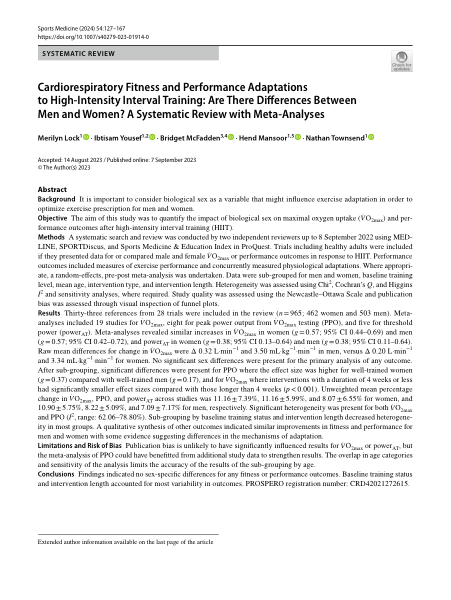
It is important to consider biological sex as a variable that might influence exercise adaptation in order to optimize exercise prescription for men and women.
Objective
The aim of this study was to quantify the impact of biological sex on maximal oxygen uptake (\(\dot{V}\)O2max) and performance outcomes after high-intensity interval training (HIIT).
Methods
A systematic search and review was conducted by two independent reviewers up to 8 September 2022 using MEDLINE, SPORTDiscus, and Sports Medicine & Education Index in ProQuest. Trials including healthy adults were included if they presented data for or compared male and female \(\dot{V}\)O2max or performance outcomes in response to HIIT. Performance outcomes included measures of exercise performance and concurrently measured physiological adaptations. Where appropriate, a random-effects, pre-post meta-analysis was undertaken. Data were sub-grouped for men and women, baseline training level, mean age, intervention type, and intervention length. Heterogeneity was assessed using Chi2, Cochran’s Q, and Higgins I2 and sensitivity analyses, where required. Study quality was assessed using the Newcastle–Ottawa Scale and publication bias was assessed through visual inspection of funnel plots.
Results
Thirty-three references from 28 trials were included in the review (n = 965; 462 women and 503 men). Meta-analyses included 19 studies for \(\dot{V}\)O2max, eight for peak power output from \(\dot{V}\)O2max testing (PPO), and five for threshold power (powerAT). Meta-analyses revealed similar increases in \(\dot{V}\)O2max in women (g = 0.57; 95% CI 0.44–0.69) and men (g = 0.57; 95% CI 0.42–0.72), and powerAT in women (g = 0.38; 95% CI 0.13–0.64) and men (g = 0.38; 95% CI 0.11–0.64). Raw mean differences for change in \(\dot{V}\)O2max were Δ 0.32 L·min−1 and 3.50 mL·kg−1·min−1 in men, versus Δ 0.20 L·min−1 and 3.34 mL·kg−1·min−1 for women. No significant sex differences were present for the primary analysis of any outcome. After sub-grouping, significant differences were present for PPO where the effect size was higher for well-trained women (g = 0.37) compared with well-trained men (g = 0.17), and for \(\dot{V}\)O2max where interventions with a duration of 4 weeks or less had significantly smaller effect sizes compared with those longer than 4 weeks (p
Description
The study reviews sex differences in fitness adaptations to high-intensity interval training.