Abstract
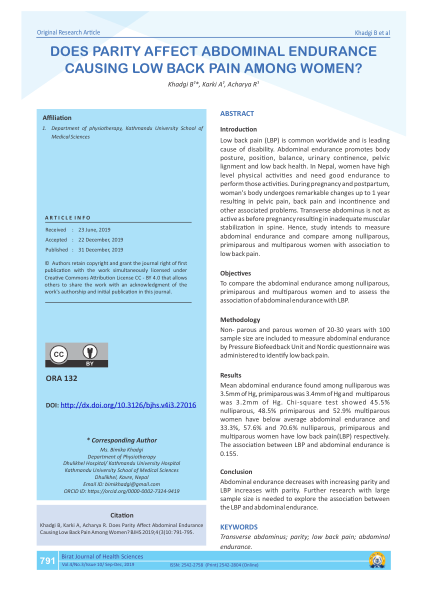
Original Research Ar Ÿcle Khadgi B et al 1. Department of physiotherapy, Kathmandu University School of Medical Sciences © Authors retain copyright and grant the journal right of ï¬rst publica Ÿon with the work simultaneously licensed under Crea Ÿve Commons A ©ri u Ÿon License CC - BY 4.0 that allows others to share the work with an acknowledgment of the work's authorship and ini Ÿal publica on in this journal. * Corresponding Author Ms. Bimika Khadgi Department of Physiotherapy Dhulikhel Hospital/ Kathmandu University Hospital Kathmandu University School of Medical Sciences Dhulikhel, Kavre, Nepal Email ID: bimikhadgi@gmail.com ORCID ID: h © ‰s: l lorcid.org/0000-0002-7324-9419 Affilia Ÿon A R T I C L E I N F O Received : 23 June, 2019 Accepted : 22 December, 2019 Published : 31 December, 2019 Cita Ÿon ORA 132 DOI: h © ‰: l ld Æ Xdoi Xorg/10.3126/bjhs.v4i3.27016 Khadgi B, Karki A, Acharya R. Does Parity Affect Abdominal Endurance Causing Low Back Pain Among Women? BJHS 2019;4 (3)10: 791-795. Introduc Ÿon Low back pain (LBP) is common worldwide and is leading cause of disability. Abdominal endurance promotes body posture, posi Ÿon, balance, urinary con Ÿnence, pelvic lignment and low back health. In Nepal, women have high level physical ac Ÿvi Ÿes and need good endurance to perform those ac Ÿvi Ÿes. During pregnancy and postpartum, woman's body undergoes remarkable changes up to 1 year resul Ÿng in pelvic pain, back pain and incon Ÿnence and other associated problems. Transverse abdominus is not as ac Ÿve as before pregnancy resul Ÿng in inadequate muscular stabiliza Ÿon in spine. Hence, study intends to measure abdominal endurance and compare among nulliparous, primiparous and mul Ÿparous women with associa Ÿon to low back pain. Ob iec Ÿves To compare the abdominal endurance among nulliparous, primiparous and mul Ÿparous women and to assess the associa Ÿon of abdominal endurance with LBP. Methodology Non- parous and parous women of 20-30 years with 100 sample size are included to measure abdominal endurance by Pressure Biofeedback Unit and Nordic ques Ÿonnaire was administered to iden Ÿfy low back pain. Results
Ÿves To compare the abdominal endurance among nulliparous, primiparous and mul Ÿparous women and to assess the associa Ÿon of abdominal endurance with LBP. Methodology Non- parous and parous women of 20-30 years with 100 sample size are included to measure abdominal endurance by Pressure Biofeedback Unit and Nordic ques Ÿonnaire was administered to iden Ÿfy low back pain. Results Mean abdominal endurance found among nulliparous was 3.5mm of Hg, primiparous was 3.4mm of Hg and mul Ÿparous was 3.2mm of Hg. Chi-square test showed 45.5% nulliparous, 48.5% primiparous and 52.9% mul Ÿparous women have below average abdominal endurance and 33.3%, 57.6% and 70.6% nulliparous, primiparous and mul Ÿparous women have low back pain(LBP) respec Ÿvely. The associa Ÿon between LBP and abdominal endurance is 0.155. Conclusion Abdominal endurance decreases with increasing parity and LBP increases with parity. Further research with large sample size is needed to explore the associa Ÿon between the LBP and abdominal endurance. KEYWORDS Transverse abdominus; parity; low back pain; abdominal endurance. DOES PARITY AFFECT ABDOMIN AL ENDURANCE CAUSING LOW BACK PAIN AMONG WOMEN? Khadgi B¹*, Karki A¹, Acharya R¹ ISSN: 2542-2758 (Print) 2542-2804 (Online) 791 Birat Journal of Health Sciences Vol.4/No.3/Issue 10/ Sep-Dec, 2019
Original Research Ar cle Khadgi B et al INTRODUCTION Low back pain (LBP) is the leading cause of years lived with 1 disability in Nepal and elsewhere.Endurance of the abdominal muscles are important in promo ng good body posture including posi on and correct pelvic alignment, 2,3 body balance and to maintain the con nence.Decrease in abdominal endurance can risk to urinary inco v Ÿnence 4 (UI),pelvic instability and LBP. According to Global Burden of Disease data, LBP is the number one cause of disability in Nepal; since 2005 the number of years lived with disability 5 due to low back pain in Nepal increased by 16.9%.LBP leads to difficul es in physical func oning, speciï¬cally walking, bending, li ing, doing household chores ul Ÿmately 5-7 decreasing quality of life(QOL). In Nepal 84.3% women are involved in agriculture and forestry which demands very high work load and burden with both farming and 8 household ac Ÿvity. The daily ac Ÿvi Ÿes of the women included in the agriculture as well as the house hold require extreme bending or twis ng of the neck and back as well as 9 carrying heavy load. Li ing up the loads and working mainly on standing and squa «ng demands ac Ÿvity of the abdominal muscles for which they need to have good 9,10 abdomin alendurance. Nepalese women con nue their household and regular work during their pregnancy and even a er delivery. During pregnancy, there is remodeling of connec ve ssues and increase in the collage noly csystem which weakens abdominal muscle and also decreases the 10 abdominals endurance. There is also hyperlordosis of lumbar spine resul ng anterior shi of center of gravity (COG), increasing the anterior pelvic lt. This increases 6,11 stress and pain in low back, pelvic and sacroiliac region.A woman's body undergoes remarkable changes not only during pregnancy but also during postpartum period. Studies showed that pelvic pain (5 to 20%), back pain (30 to 45%) and UI (29%) occurs due to decrease in abdominal 11-13 endurance during postpartum period. This can compromise QOL decreasing par Ÿcip Ÿon in
stress and pain in low back, pelvic and sacroiliac region.A woman's body undergoes remarkable changes not only during pregnancy but also during postpartum period. Studies showed that pelvic pain (5 to 20%), back pain (30 to 45%) and UI (29%) occurs due to decrease in abdominal 11-13 endurance during postpartum period. This can compromise QOL decreasing par Ÿcip Ÿon in physical ac vi es and doing household chores. The endurance or the ac va on of the deepest abdominal muscle Transverse Abdominus muscle (TrA), a dynamic muscular corset, assist in postural control and stabiliza on 20-22 of the lumbar spine. Over stretching of the abdominal muscles during pregnancy results in adequate muscular stabiliza on of the lumbar spine causing LBP, pelvic girdle 14 pain(PGP), UI and also reduces the laxity of SI joint. All these factors are responsible for limita on in daily living ac Ÿvi Ÿes due to physicalin ac Ÿvity and disability and µ o Ÿ u tely decreases QOL. Early iden Ÿ . a on of TrA ac vity helps in preven ng problems and also to know whether abdominal endurance is affected by parity or not. Therefore, this study aims to measure the abdomin alendurance in nulliparous, primiparous and u µ o Ÿ ‰ Œous women and to comprehend the associa on of abdominal endurance with LBP. METHODOLOGY The Cross sec Ÿonal study with convenient purposive sampling was done among 100 women and divided them into three groups of nulliparous, primiparous and u µ o Ÿ ‰ Œous with inclusion criteria of female with age 20-30 years with dura on of at least 1 year child birth. Women with Spinal or recent abdominal surgery including caesarean birth (1 year dura Ÿ } v U ‰ Œegnant women, women involved in abdominal exercise, and serious pathologies (e.g.lumbar fracture, cancer, infec Ÿous diseases of the spine, neurological disorders) were excluded from the study. A er official permission received from Dhulikhel Municipality and from Ins tu onal Review Commi ©ee data collec on was started. The demographic data of par Ÿcipants (nulliparous, primiparous and u µ o Ÿ ‰
women, women involved in abdominal exercise, and serious pathologies (e.g.lumbar fracture, cancer, infec Ÿous diseases of the spine, neurological disorders) were excluded from the study. A er official permission received from Dhulikhel Municipality and from Ins tu onal Review Commi ©ee data collec on was started. The demographic data of par Ÿcipants (nulliparous, primiparous and u µ o Ÿ ‰ Œous) were recorded and screened according to selec on criteria 100 women divided in three groups: thirty- three nulliparous and primiparous and whereas u µ o Ÿ ‰ Œous was thirty four. The par cipants were explained about the purpose, risks and beneï¬ts of the study. Verbal and Ári ©en consent were taken from selected par cipants prior to data collec on. Pressure Biofeedback Unit (PBU) is a tool that quan Ÿ ša Ÿ Àely measures the ac va on and endurance of the TrA with 21-23 excellent psychometric proper Ÿes. Nordic Musculoskeletal Ques Ÿonnaire (NMQ) is a screening tool of the musculoskeletal disorders, used as self-administered ques Ÿ } v v ] Œes or as 19 interview and is a body part speciï¬c ques Ÿ } v v ] Œe. In NMQ, body chart is showed to mark any painful area such as 15,27 back (upper and lower), neck, hand, elbow, knee and foot. For BMI, inch tape and weighing machine was used by researcher and to measurethe abdominal endurance, Pressure Biofeedback of Cha ©anooga ISO 13485 Cer ï¬ed Company was used, to measures the fa Ÿgue Ÿme of the deep 21 abdominal muscles. The Pressure Bio feedback Unit (PBU) is a simple pressure transducer consis Ÿng of a three-chamber: air-ï¬led pressure bag, catheter and a sphygmomanometer gauge. Par cipants were placed on prone posi on, arms at side; head fully relaxed in the midline and feet off the plinth for the measurement. The procedures were explained and demonstrated at ï¬rst. Then the inflatable cell was placed centrally beneath the abdomen between the lower edge at the level of the anterior superior Iliac spines (ASIS) and umbilicus. The subjects were verbally instructed to contract their TrA selec Ÿvely using
head fully relaxed in the midline and feet off the plinth for the measurement. The procedures were explained and demonstrated at ï¬rst. Then the inflatable cell was placed centrally beneath the abdomen between the lower edge at the level of the anterior superior Iliac spines (ASIS) and umbilicus. The subjects were verbally instructed to contract their TrA selec Ÿvely using an abdominal drawing-in maneuver as “Draw in your abdomen without moving the spine or pelvis†and maintain these contrac ons for ten seconds (by stopwatch) with normal breathing pa ©ern. Before star ng the contrac on, the bag was inflated to a 792 ISSN: 2542-2758 (Print) 2542-2804 (Online) Birat Journal of Health Sciences Vol.4/No.3/Issue 10/ Sep-Dec, 2019
Original Research Ar cle Khadgi B et al pressure of 70mmHg with the valve closed. Par cipants were instructed to inspire and expire deeply using mainly abdominal wall and par cipants were asked to relax, then the inflatable bag was adjusted again to 70 mmHg. The ability to contract the TrA muscle results in a pressure reduc on from 4 to 10 mmHg, recorded by pressure gauge of PBU, is known as good contrac lity of TrA. Contrac ons with visible co-contrac Ÿons of other muscles (gluteal, quadriceps or back muscles, l ng of the pelvis or flexing of the spine) with pressure reduc ons of 0 mm Hg or posi ve values, were not registered. Then subjects were given a new trial. The mean score of three trials were noted. A er this Nordic Musculoskeletal Ques Ÿonnaire (NMQ) was administered by interview method for the LBP and the body chart was shown to mark the painful region. A er data collec on, the data were entered in SPSS-16 for further analysis. Par Ÿcipants demographic (age, BMI, gravida, parity, mode of delivery, dura on a er delivery) represented in form of descrip ve sta Ÿ cs. Chi-square test is used for the comparison of abdominal endurance and associa on with LBP. RESULT The data was collected from the women residing in Dhulikhel community using pressure biofeedback and self-administered ques Ÿ } v v ] Œe-Nordic musculoskeletal ques Ÿ } v v ] Œe, were analyzed and interpreted. Out of 100 women par cipants, majority (56%) were between 25-30 years and most of them were housewives. Most of the par cipants are educated. The socio-demographic of the women are shown in Table no 1. The maximum par Ÿcipants had normal delivery with episiotomy. 72% of the par cipant's has 1-5 years birth spacing between last 2 deliveries. The obstetric characteris cs are shown in table no 2. The mean endurance among nulliparous is 3.4760 mm of Hg, primiparous is 3.3919 mm of Hg and u µ o Ÿ ‰ Œous is 3.1829 mm of Hg which is shown in table
delivery with episiotomy. 72% of the par cipant's has 1-5 years birth spacing between last 2 deliveries. The obstetric characteris cs are shown in table no 2. The mean endurance among nulliparous is 3.4760 mm of Hg, primiparous is 3.3919 mm of Hg and u µ o Ÿ ‰ Œous is 3.1829 mm of Hg which is shown in table no 3. Table 1: Characteris cs of the par cipants. Table 2: Obstetric characteris cs of women Table 3: Mean abdominal endurance and parity. Abdominal endurance among women: Out of 33 nulliparous, 33primiparous and 34 u µ o Ÿ ‰ Œous women 45.5%, 48.5% and 52.9% have below average abdominal endurance respec vely as shown in below. Abdominal endurance and Parity 46% 49% poor good endurance 56% 54% 52% 50% 48% 46% 44% 42% 40% 52.90% 55% 52% 47% NulliparousPrimiparousMul parous Figure 1: abdominal endurance and parity Parity and low back pain: Bar graph 2 showed that nulliparous women 33.3% (n=11) have LBP, among primiparous women 57.6% (n=19) have LBP and majority of u µ o Ÿ ‰ Œous 70.6 %(n=24) have LBP. Abdominal endurance and low back pain: Among 49 par cipants with poor abdominal endurance majority (n=30) have low back pain and among 51 par Ÿcipants with good abdominal endurance majority Figure 2: Parity and LBP ISSN: 2542-2758 (Print) 2542-2804 (Online) 793 Birat Journal of Health Sciences Vol.4/No.3/Issue 10/ Sep-Dec, 2019
Original Research Ar cle Khadgi B et al (n=27) doesn't have low back pain. There is signiï¬cant associa on between parity and LBP with p value 0.004 but no associa on between parity and endurance as shown in table no. 4. The associa on between LBP and abdominal endurance is 0.155 which is not signiï¬cant as well. Table 4: Associa on of Parity with LBP and Abdominal Endurance DISCUSSION The objec ve of this study is to measure the abdominal endurance among nulliparous, primiparous and mul Ÿparous women and also to see the associa Ÿon between abdominal endurance and LBP with parity. This study strongly supports that there will be change in abdominal endurance among nulliparous, primiparous and u µ o Ÿ ‰ Œous women. Abdominal muscle func on deï¬cit is present during pregnancy due to more stretch of abdominals 12 and as parity increases its func on will be reduced more. For normal vaginal delivery with or without episiotomy pelvic floor muscle func on is decreased according to the 28 study conducted by Hilde G et al, 2013. Abdominal endurance or the ac vity of transverse abdominus is also decreased among the women who have decreased pelvic floor muscle func Ÿon according to the study done by 29 Stephanie J. Madill et al, 2006. This study showed similar result done by Liaw L et al that abdominal endurance 11 decreases with increase in parity. a µ o Ÿ ‰ Œous has low abdominal endurance than primiparous and primiparous has low abdominal endurance than nulliparous. However, there are limited studies done speciï¬cally examining the abdominal endurance a er 1 year of delivery but we found evidence more on that abdominal func on decreases up to 12 6 month postpartum than nulliparous females. As Nepalese women have high work load and their household ac vity requires extreme bending or twis ng of the neck and back with li ing loads, their work posi on mainly is standing and squa «ng which require good abdominal 9,10 endurance. They have to con nue these work during their pregnancy and even a er delivery.
nulliparous females. As Nepalese women have high work load and their household ac vity requires extreme bending or twis ng of the neck and back with li ing loads, their work posi on mainly is standing and squa «ng which require good abdominal 9,10 endurance. They have to con nue these work during their pregnancy and even a er delivery. Abdominal muscle func on deï¬cit is present during pregnancy due to more stretch of abdominals. This might be the reason that abdominal endurance decreases with parity. Low back pain is one of the common problem which is considered as 6 normal during pregnancy with prevalence of 20% to 84%. The incidence of back pain in postpartum women has also been quoted to be between 30% and 45% a er 2 years and 26 20% in 6 years. Our study supported the result published by The in-Nissenbaum et al showing low back pain is present 25 during postpartum period. It may be due to the more decrease in abdominal func on or endurance with increase with number of pregnancy. With less abdominal func on combined with more workload or household chores might be the reason behind the increased low back pain. Mul parity displayed an increased risk of musculoskeletal condi ons, due to the repeated weight strain, stretching of abdominals decreasing in abdominal func on, endurance and strength. Addi Ÿonally, each new child in a family increases the workload in early motherhood like repeated 27 li ing causing back pain. In this study par cipant who complaint back pain were asked about three difficult ac Ÿvi Ÿes with household and they complained mainly washing clothes as it requires bending forward and also during prolonged standing and si «ng aggravates pain. Washing clothes and si «ng requires squa «ng posi on which stretches the pelvic floor muscles causing its weakness. This results in less ac va on of abdominals 26 causing more back pain. More back pain might be because 27 these ac vi es needs more func on of back stabilizers. Low back pain is the number one cause of disability
clothes and si «ng requires squa «ng posi on which stretches the pelvic floor muscles causing its weakness. This results in less ac va on of abdominals 26 causing more back pain. More back pain might be because 27 these ac vi es needs more func on of back stabilizers. Low back pain is the number one cause of disability in Nepal 1 and the burden is increasing. In this study we couldn't ï¬nd the associa on of abdominal endurance with low back pain, though par Ÿcipants complained of low back pain with increasing parity and they had less abdominal endurance. Reason for this may be the small sample size in the study. Research done in rural Nepal reported 28% pelvic organ 17 prolapse among adolescent women 20-29 age group. The mean age of the women in our study is also 25-30 years. LBP was common among nulliparous with 33% and primiparous with 57% and mul Ÿparous with 70%. This shows the disability is increasing as the parity is increasing. LBP could be one the symptom for the POP among the women which 16 has to be iden ï¬ed early for the be ©erment of QOL. Habitua on of LBP with increase in me can also be another reason behind it. Therefore, our study showed that abdominal endurance decreases along with increase in parity and low back pain also increases along with parity but LBP was not associated with parity in our study. CONCLUSION This study concluded that abdominal endurance decreases with increase in parity. We also found that LBP was more common in mul Ÿparous women as compared to primiparous and nulliparous women. This study showed that there is no associa on between abdominal endurance and low back pain but the future study with large popula on will give more detail picture about this. RECOMMENDATIONS Based on the results and ï¬nding of study we would like to recommend for the following: ·Socio cultural barriers affec ng abdominal endurance should be assessed in future studies. ·L v ] Ÿ te proper postpartum rehabilita on protocol with respect to socio cultural
but the future study with large popula on will give more detail picture about this. RECOMMENDATIONS Based on the results and ï¬nding of study we would like to recommend for the following: ·Socio cultural barriers affec ng abdominal endurance should be assessed in future studies. ·L v ] Ÿ te proper postpartum rehabilita on protocol with respect to socio cultural need of Nepalese women ·Abdominal strengthening and endurance exercises should be incorporated during pregnancy and postpartum. 794 ISSN: 2542-2758 (Print) 2542-2804 (Online) Birat Journal of Health Sciences Vol.4/No.3/Issue 10/ Sep-Dec, 2019