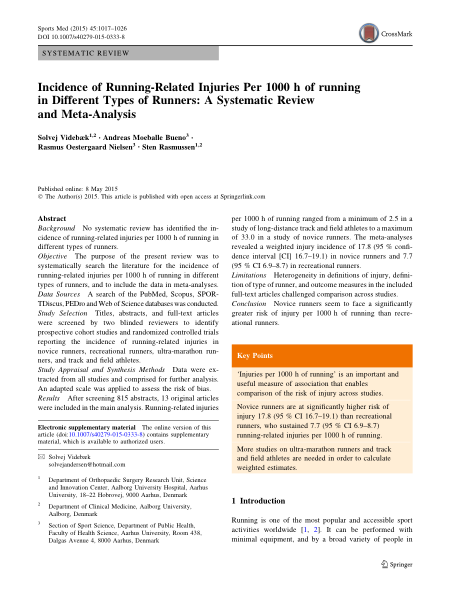
Abstract
Background
Despite a rapidly growing body of research, a systematic evidence compilation of the risk and protective factors for middle- and long-distance running-related injury (RRI) was lacking.
Objectives
Our objective was to compile the evidence about modifiable and non-modifiable training-related and behavioral risk and protective factors for middle- and long-distance RRI.
Methods
We searched five databases (PubMed, CINAHL, MEDLINE, SPORTDiscus, and PsycINFO) for the dates 1 January 1970 to 31 December 2015, inclusive, for original peer-reviewed articles. The eligible designs were cross-sectional, case–control, longitudinal observational studies, and randomized controlled trials involving runners competing at distances from ≥800 m to ≤42.2 km. Outcomes were any specific and/or general RRI, and exposures included training-related and behavioral factors. We extracted authors and date, study design, injury type(s), descriptors and comparators for each exposure, and results and measures of association from the selected studies. Methodological quality was independently appraised using two separate checklists: a modified checklist for observational study designs and the Physiotherapy Evidence Database (PEDro) scale for randomized controlled trials.
Results
Among 73 articles eligible for inclusion, 19 (26.0%) and 30 (41.0%) were of high or satisfactory methodological quality, respectively. As a non-modifiable exposure, a history of previous injury was found to be associated with an increased risk of both general and specific RRI. In terms of modifiable exposures, irregular and/or absent menstruation was found to be associated with an increased risk of stress fracture development, whereas the use of oral contraceptives was found to be associated with a decreased risk. High clinical, methodological, and statistical heterogeneity meant it was not feasible to estimate a pooled effect size across similar studies.
Conclusions
A history of previous injury was associated with an increased risk of both general and specific RRI. The use of oral contraceptives was found to be associated with a decreased risk of skeletal stress fracture. Conversely, irregular and/or absent menstruation was associated with an increased risk. The varied effect directions and/or a number of statistically insignificant results associated with the majority of factors hindered our ability to draw any definitive conclusions about their relationship to RRI risk.
This is a preview of subscription content, log in via an institution
to check access.
Description
The study analyzes injury rates among various runner types.