Abstract
ealth Sciences, Alagappa University, Karaikudi,-630 004, Tamilnadu, India. Test Plyometric Training Group-I Complex Training Group-II Control Group-III Source of Variance Sum of Squares df Mean
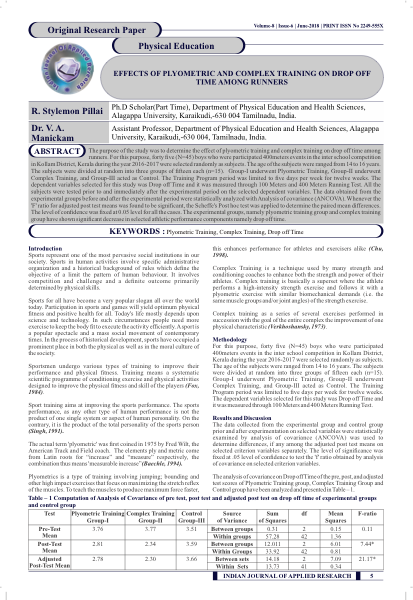
experimental groups, namely plyometric training group and complex training group have shown significant decrease in selected athletic performance components namely drop off time. ABSTRACT Dr. V. A. Manickam Assistant Professor, Department of Physical Education and Health Sciences, Alagappa University, Karaikudi,-630 004, Tamilnadu, India. Test Plyometric Training Group-I Complex Training Group-II Control Group-III Source of Variance Sum of Squares df Mean Squares F-ratio Pre-Test Mean 3.76 3.77 3.51Between groups 0.31 2 0.15 0.11 Within groups 57.28 42 1.36 Post-Test Mean 2.81 2.34 3.59Between groups12.011 2 6.01 7.44* Within Groups 33.92 42 0.81 Adjusted Post-Test Mean 2.78 2.30 3.66 Between sets 14.18 2 7.09 21.17* Within Sets13.73 41 0.34 Table – 1 Computation of Analysis of Covariance of pre test, post test and adjusted post test on drop off time of experimental groups and control group Volume-8 | Issue-6 | June-2018 | PRINT ISSN No 2249-555X
* Significant at 0.05 level of confidence Table value for df (2, 42) at 0.05 level = 3.22 Table value for df (2, 41) at 0.05 level = 3.23 (Drop off Time scores are in Seconds) Table-1 shows that the pre test mean values of Drop off Time for Plyometric Training, Complex Training and Control group are 3.76, 3.77 and 3.51 respectively. The obtained F-ratio value is 0.11, which is less than the required table value of 3.22 for significance with df 2 and 42 at 0.05 level of confidence. The post test mean values of Drop off Time for Plyometric Training, Complex Training and Control group are 2.81, 3.24 and 3.59 respectively. The obtained F-ratio value is 7.44, which is more than the required table value of 3.22 for significance with df 2 and 42 at 0.05 level of confidence. The adjusted post test mean values of Drop off Time for Plyometric Training, Complex Training and Control group are 2.78, 2.30 and 3.66 respectively. The obtained F-ratio value is 21.17, which is more than the required table value of 3.22 for significance with df 2 and 42 at 0.05 level of confidence. The results of the study indicated that there is a significant difference between the post test means and adjusted post-test means of Plyometric Training group, Complex Training Group and Control group on Drop off Time. Since, three groups are compared and whenever the obtained 'F' ratio for adjusted post test is found to be significant, Scheffe's test is used to find out the paired mean difference and it is presented in Table-2. Table – 2 Scheffe's test for the difference between paired means on Drop off time *Significant at 0.05 level of confidence. Table-2 shows that the mean difference values of Drop off Time between Plyometric Training group and Control group, Complex Training group and Control group are 0.88 and 1.36 respectively, which are greater than the confidence interval value of 0.54 on Drop off Time at 0.05 level of confidence. The results of the study showed that there was a significant difference between Plyometric Training group
mean difference values of Drop off Time between Plyometric Training group and Control group, Complex Training group and Control group are 0.88 and 1.36 respectively, which are greater than the confidence interval value of 0.54 on Drop off Time at 0.05 level of confidence. The results of the study showed that there was a significant difference between Plyometric Training group and Complex Training group, Plyometric Training group and Control group, Complex Training group and Control group. Further the Table-2 shows that the mean difference values of Drop off Time between Plyometric Training group and Complex Training group, is 0.48, which is less than the confidence interval value of 0.54 on Drop off Time at 0.05 level of confidence. The results of the study showed that there was no significant difference between Plyometric Training group and Complex Training group. The above data also reveal that Complex Training group had shown better performance than Plyometric Training group and Control in Drop off Time. The pre and post test mean values of Plyometric Training group, Complex Training group and Control group on Drop off Time are graphically represented in the Figure-1. The adjusted post mean values of Plyometric Training group, Complex Training group and Control group on Drop off Time are graphically represented in the Figure -2. Figure: 1 The Pre and Post test Mean values of Plyometric Training group, Complex Training group and Control group on Drop off Time (Scores in Seconds) Figure: 2 The Adjusted Post Test Mean values of Plyometric Training group, Complex Training group and Control group on Drop off Time(Scores in Seconds) Conclusion From the analysis of the data, Complex Training Group showed significantly decrease in the Drop off Time, when compared to the Plyometric training and control group. References 1. Baechle R. Thomas, (1994), Essentials of Strength Training and Conditioning. Champaign, Illinois: Human Kinetics Publishers. 2. Chu, Donald (1998), Jumping into plyometrics (2nd ed.). Champaign, IL: Human Kinetics. pp. 1 4. 3. Fox, Edward, L(1984), Sports Physiology, Philadelphia: Saunders College Publishers. 4. Singh Hardayal (1991), Science of Sports Training, New Delhi: DVS Publications. 5. Verkhoshansky Y(1966), Perspectives
group. References 1. Baechle R. Thomas, (1994), Essentials of Strength Training and Conditioning. Champaign, Illinois: Human Kinetics Publishers. 2. Chu, Donald (1998), Jumping into plyometrics (2nd ed.). Champaign, IL: Human Kinetics. pp. 1 4. 3. Fox, Edward, L(1984), Sports Physiology, Philadelphia: Saunders College Publishers. 4. Singh Hardayal (1991), Science of Sports Training, New Delhi: DVS Publications. 5. Verkhoshansky Y(1966), Perspectives in the improvement of speed-strength preparation of jumpers, Track Field, 9: 11–12 6 INDIAN JOURNAL OF APPLIED RESEARCH Plyometric Training Group-I Complex Training Group-II Control Group Mean Difference Confident Interval Value 2.78 2.30 --- 0.48 0.54 2.78 --- 3.66 0.88* --- 2.30 3.66 1.36* Volume-8 | Issue-6 | June-2018 | PRINT ISSN No 2249-555X
Description
This research investigates training effects on athletic performance in young runners.