Abstract
Objectives
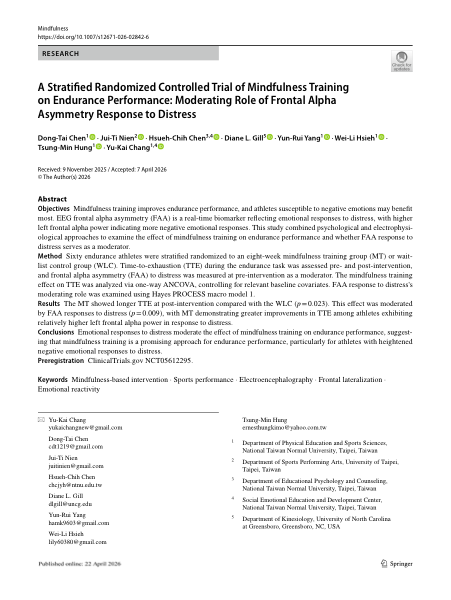
Mindfulness training improves endurance performance, and athletes susceptible to negative emotions may benefit most. EEG frontal alpha asymmetry (FAA) is a real-time biomarker reflecting emotional responses to distress, with higher left frontal alpha power indicating more negative emotional responses. This study combined psychological and electrophysiological approaches to examine the effect of mindfulness training on endurance performance and whether FAA response to distress serves as a moderator.
Method
Sixty endurance athletes were stratified randomized to an eight-week mindfulness training group (MT) or wait-list control group (WLC). Time-to-exhaustion (TTE) during the endurance task was assessed pre- and post-intervention, and frontal alpha asymmetry (FAA) to distress was measured at pre-intervention as a moderator. The mindfulness training effect on TTE was analyzed via one-way ANCOVA, controlling for relevant baseline covariates. FAA response to distress's moderating role was examined using Hayes PROCESS macro model 1.
Results
The MT showed longer TTE at post-intervention compared with the WLC (p = 0.023). This effect was moderated by FAA responses to distress (p = 0.009), with MT demonstrating greater improvements in TTE among athletes exhibiting relatively higher left frontal alpha power in response to distress.
Conclusions
Emotional responses to distress moderate the effect of mindfulness training on endurance performance, suggesting that mindfulness training is a promising approach for endurance performance, particularly for athletes with heightened negative emotional responses to distress.
Preregistration
ClinicalTrials.gov NCT05612295.
Description
This study examines the effects of mindfulness training on endurance performance and emotional responses.