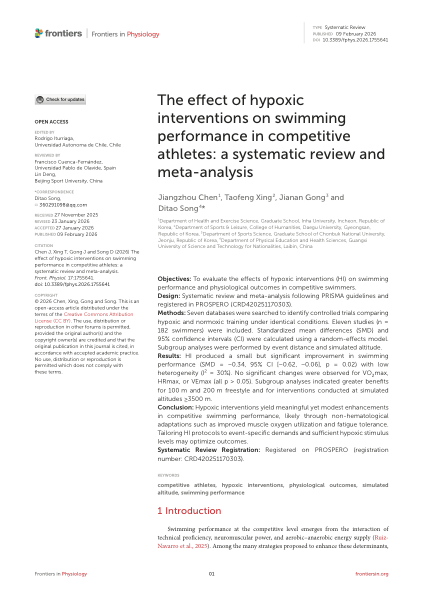
Abstract
Objectives:
To evaluate the effects of hypoxic interventions (HI) on swimming performance and physiological outcomes in competitive swimmers.
Design:
Systematic review and meta-analysis following PRISMA guidelines and registered in PROSPERO (CRD420251170303).
Methods:
Seven databases were searched to identify controlled trials comparing hypoxic and normoxic training under identical conditions. Eleven studies (n = 182 swimmers) were included. Standardized mean differences (SMD) and 95% confidence intervals (CI) were calculated using a random-effects model. Subgroup analyses were performed by event distance and simulated altitude.
Results:
HI produced a small but significant improvement in swimming performance (SMD = −0.34, 95% CI [−0.62, −0.06], p = 0.02) with low heterogeneity (I2 = 30%). No significant changes were observed for VO2max, HRmax, or VEmax (all p > 0.05). Subgroup analyses indicated greater benefits for 100 m and 200 m freestyle and for interventions conducted at simulated altitudes ≥3500 m.
Conclusion:
Hypoxic interventions yield meaningful yet modest enhancements in competitive swimming performance, likely through non-hematological adaptations such as improved muscle oxygen utilization and fatigue tolerance. Tailoring HI protocols to event-specific demands and sufficient hypoxic stimulus levels may optimize outcomes.
Systematic Review Registration:
Registered on PROSPERO (registration number: CRD420251170303).
Description
This systematic review analyzes the impact of hypoxic training on swimming performance.