Abstract
Purpose:
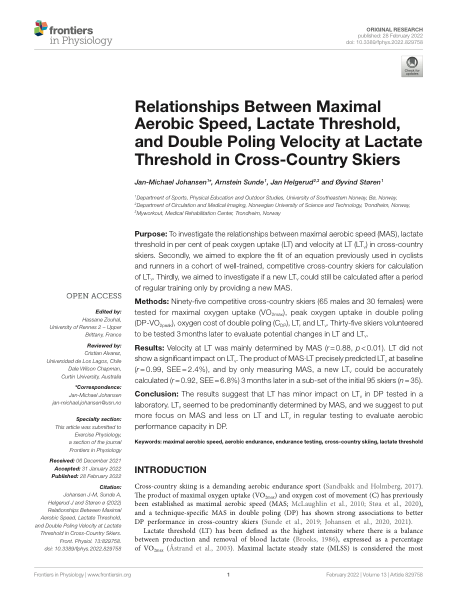
To investigate the relationships between maximal aerobic speed (MAS), lactate threshold in per cent of peak oxygen uptake (LT) and velocity at LT (LTv) in cross-country skiers. Secondly, we aimed to explore the fit of an equation previously used in cyclists and runners in a cohort of well-trained, competitive cross-country skiers for calculation of LTv. Thirdly, we aimed to investigate if a new LTv could still be calculated after a period of regular training only by providing a new MAS.
Methods:
Ninety-five competitive cross-country skiers (65 males and 30 females) were tested for maximal oxygen uptake (VO2max), peak oxygen uptake in double poling (DP-VO2peak), oxygen cost of double poling (CDP), LT, and LTv. Thirty-five skiers volunteered to be tested 3 months later to evaluate potential changes in LT and LTv.
Results:
Velocity at LT was mainly determined by MAS (r = 0.88, p . The product of MAS·LT precisely predicted LT at baseline ( = 0.99, SEE = 2.4%), and by only measuring MAS, a new LT could be accurately calculated ( = 0.92, SEE = 6.8%) 3 months later in a sub-set of the initial 95 skiers ( = 35).
in DP tested in a laboratory. LT seemed to be predominantly determined by MAS, and we suggest to put more focus on MAS and less on LT and LT in regular testing to evaluate aerobic performance capacity in DP.
Description
Study explores relationships between MAS, LT, and LTv in competitive cross-country skiers.