Abstract
Purpose
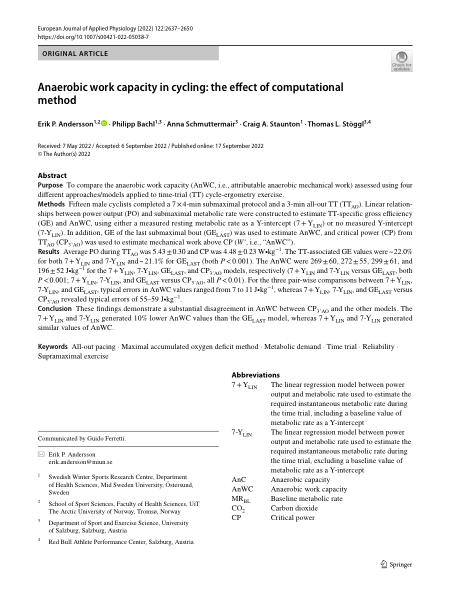
To compare the anaerobic work capacity (AnWC, i.e., attributable anaerobic mechanical work) assessed using four different approaches/models applied to time-trial (TT) cycle-ergometry exercise.
Methods
Fifteen male cyclists completed a 7 × 4-min submaximal protocol and a 3-min all-out TT (TTAO). Linear relationships between power output (PO) and submaximal metabolic rate were constructed to estimate TT-specific gross efficiency (GE) and AnWC, using either a measured resting metabolic rate as a Y-intercept (7 + YLIN) or no measured Y-intercept (7-YLIN). In addition, GE of the last submaximal bout (GELAST) was used to estimate AnWC, and critical power (CP) from TTAO (CP3´AO) was used to estimate mechanical work above CP (W’, i.e., “AnWC”).
Results
Average PO during TTAO was 5.43 ± 0.30 and CP was 4.48 ± 0.23 W∙kg−1. The TT-associated GE values were ~ 22.0% for both 7 + YLIN and 7-YLIN and ~ 21.1% for GELAST (both P
Description
This study compares different methods for assessing anaerobic work capacity in cycling.