Abstract
Introduction
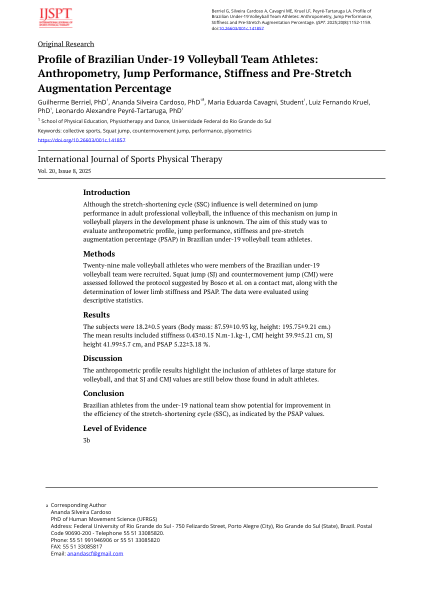
Although the stretch-shortening cycle (SSC) influence is well determined on jump performance in adult professional volleyball, the influence of this mechanism on jump in volleyball players in the development phase is unknown. The aim of this study was to evaluate anthropometric profile, jump performance, stiffness and pre-stretch augmentation percentage (PSAP) in Brazilian under-19 volleyball team athletes.
Methods
Twenty-nine male volleyball athletes who were members of the Brazilian under-19 volleyball team were recruited. Squat jump (SJ) and countermovement jump (CMJ) were assessed followed the protocol suggested by Bosco et al. on a contact mat, along with the determination of lower limb stiffness and PSAP. The data were evaluated using descriptive statistics.
Results
The subjects were 18.2±0.5 years (Body mass: 87.59±10.93 kg, height: 195.75±9.21 cm.) The mean results included stiffness 0.43±0.15 N.m-1.kg-1, CMJ height 39.9±5.21 cm, SJ height 41.99±5.7 cm, and PSAP 5.22±3.18 %.
Discussion
The anthropometric profile results highlight the inclusion of athletes of large stature for volleyball, and that SJ and CMJ values are still below those found in adult athletes.
Conclusion
Brazilian athletes from the under-19 national team show potential for improvement in the efficiency of the stretch-shortening cycle (SSC), as indicated by the PSAP values.
Level of Evidence
3b
Description
Evaluates performance metrics in young volleyball athletes.