Abstract
Introduction:
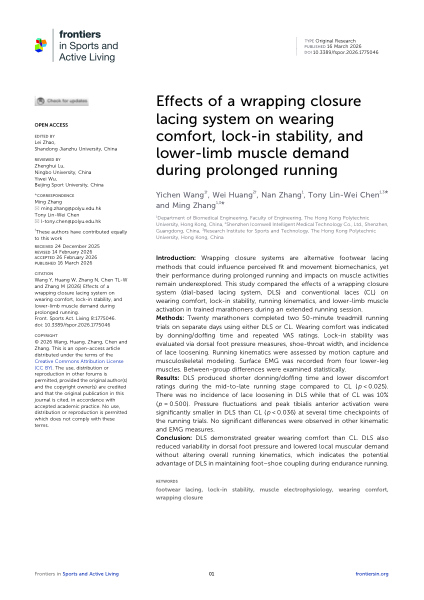
Wrapping closure systems are alternative footwear lacing methods that could influence perceived fit and movement biomechanics, yet their performance during prolonged running and impacts on muscle activities remain underexplored. This study compared the effects of a wrapping closure system (dial-based lacing system, DLS) and conventional laces (CL) on wearing comfort, lock-in stability, running kinematics, and lower-limb muscle activation in trained marathoners during an extended running session.
Methods:
Twenty marathoners completed two 50-minute treadmill running trials on separate days using either DLS or CL. Wearing comfort was indicated by donning/doffing time and repeated VAS ratings. Lock-in stability was evaluated via dorsal foot pressure measures, shoe-throat width, and incidence of lace loosening. Running kinematics were assessed by motion capture and musculoskeletal modeling. Surface EMG was recorded from four lower-leg muscles. Between-group differences were examined statistically.
Results:
DLS produced shorter donning/doffing time and lower discomfort ratings during the mid-to-late running stage compared to CL (p = 0.500). Pressure fluctuations and peak tibialis anterior activation were significantly smaller in DLS than CL (
Description
The study evaluates a new lacing system's impact on running comfort and biomechanics.