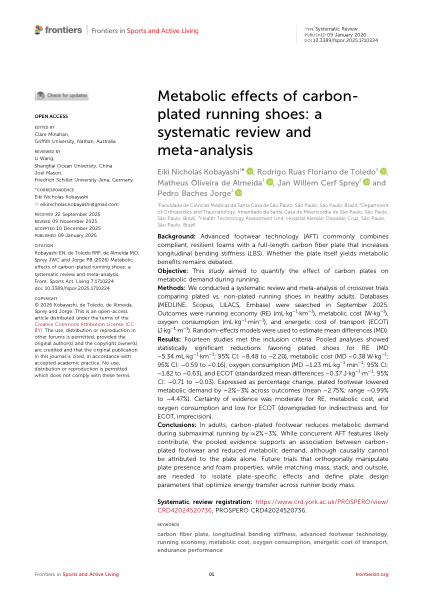
Abstract
Background:
Advanced footwear technology (AFT) commonly combines compliant, resilient foams with a full-length carbon fiber plate that increases longitudinal bending stiffness (LBS). Whether the plate itself yields metabolic benefits remains debated.
Objective:
This study aimed to quantify the effect of carbon plates on metabolic demand during running.
Methods:
We conducted a systematic review and meta-analysis of crossover trials comparing plated vs. non-plated running shoes in healthy adults. Databases (MEDLINE, Scopus, LILACS, Embase) were searched in September 2025. Outcomes were running economy (RE) (mL·kg−1·km−1), metabolic cost (W·kg−1), oxygen consumption (mL·kg−1·min−1), and energetic cost of transport (ECOT) (J·kg−1·m−1). Random-effects models were used to estimate mean differences (MD).
Results:
Fourteen studies met the inclusion criteria. Pooled analyses showed statistically significant reductions favoring plated shoes for RE (MD −5.34 mL·kg−1·km−1; 95% CI: −8.48 to −2.20), metabolic cost (MD −0.38 W·kg−1; 95% CI: −0.59 to −0.16), oxygen consumption (MD −1.23 mL·kg−1·min−1; 95% CI: −1.82 to −0.63), and ECOT (standardized mean differences −0.37 J·kg−1·m−1; 95% CI: −0.71 to −0.03). Expressed as percentage change, plated footwear lowered metabolic demand by ∼2%–3% across outcomes (mean −2.75%; range −0.99% to −4.47%). Certainty of evidence was moderate for RE, metabolic cost, and oxygen consumption and low for ECOT (downgraded for indirectness and, for ECOT, imprecision).
Conclusions:
In adults, carbon-plated footwear reduces metabolic demand during submaximal running by ≈2%–3%. While concurrent AFT features likely contribute, the pooled evidence supports an association between carbon-plated footwear and reduced metabolic demand, although causality cannot be attributed to the plate alone. Future trials that orthogonally manipulate plate presence and foam properties, while matching mass, stack, and outsole, are needed to isolate plate-specific effects and define plate design parameters that optimize energy transfer across runner body mass.
Systematic review registration:
https://www.crd.york.ac.uk/PROSPERO/view/CRD42024520736, PROSPERO CRD42024520736.
Description
Carbon-plated footwear reduces metabolic demand during submaximal running by approximately 2%-3%.