Abstract
Purpose
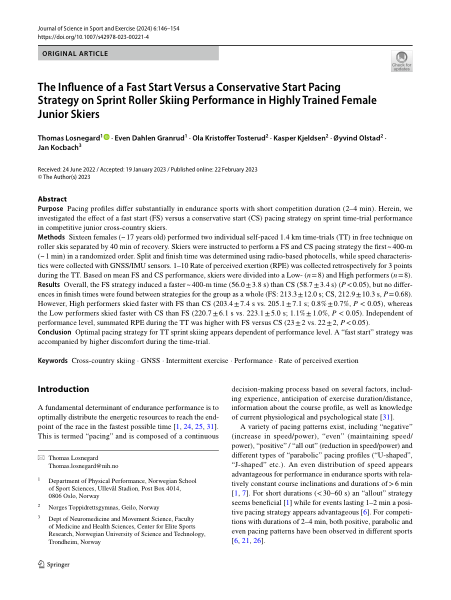
Pacing profiles differ substantially in endurance sports with short competition duration (2–4 min). Herein, we investigated the effect of a fast start (FS) versus a conservative start (CS) pacing strategy on sprint time-trial performance in competitive junior cross-country skiers.
Methods
Sixteen females (~ 17 years old) performed two individual self-paced 1.4 km time-trials (TT) in free technique on roller skis separated by 40 min of recovery. Skiers were instructed to perform a FS and CS pacing strategy the first ~ 400-m (~ 1 min) in a randomized order. Split and finish time was determined using radio-based photocells, while speed characteristics were collected with GNSS/IMU sensors. 1–10 Rate of perceived exertion (RPE) was collected retrospectively for 3 points during the TT. Based on mean FS and CS performance, skiers were divided into a Low- (n = 8) and High performers (n = 8).
Results
Overall, the FS strategy induced a faster ~ 400-m time (56.0 ± 3.8 s) than CS (58.7 ± 3.4 s) (P
Description
The study examines pacing strategies in sprint roller skiing among junior female athletes.