Abstract
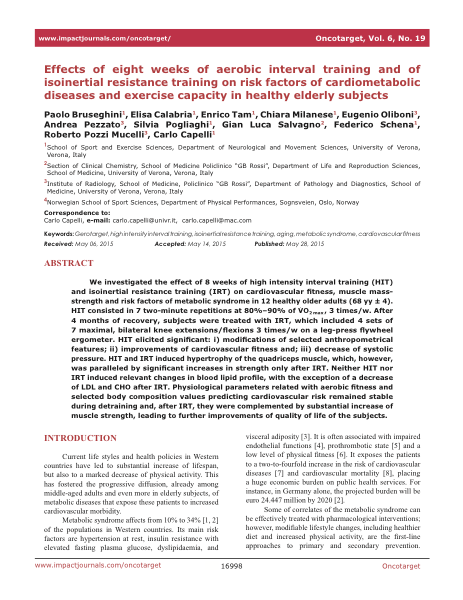
Paolo Bruseghini1, Elisa Calabria1, Enrico Tam1, Chiara Milanese1, Eugenio Oliboni3, Andrea Pezzato3, Silvia Pogliaghi1, Gian Luca Salvagno2, Federico Schena1, Roberto Pozzi Mucelli3, Carlo Capelli1 1School of Sport and Exercise Sciences, Department of Neurological and Movement Sciences, University of Verona, Verona, Italy 2Section of Clinical Chemistry, School of Medicine Policlinico “GB Rossi”, Department of Life and Reproduction Sciences, School of Medicine, University of Verona, Verona, Italy 3Institute of Radiology, School of Medicine, Policlinico “GB Rossi”, Department of Pathology and Diagnostics, School of Medicine, University of Verona, Verona, Italy 4Norwegian School of Sport Sciences, Department of Physical Performances, Sognsveien, Oslo, Norway Correspondence to: Carlo Capelli, e-mail: carlo.capelli@univr.it, carlo.capelli@mac.com Keywords: Gerotarget, high intensity interval training, isoinertial resistance training, aging, metabolic syndrome, cardiovascular fitness Received: May 06, 2015 Accepted: May 14, 2015 Published: May 28, 2015 ABSTRACT We investigated the effect of 8 weeks of high intensity interval training (HIT) and isoinertial resistance training (IRT) on cardiovascular fitness, muscle mass-strength and risk factors of metabolic syndrome in 12 healthy older adults (68 yy ± 4). HIT consisted in 7 two-minute repetitions at 80%–90% of VË™O2max, 3 times/w. After 4 months of recovery, subjects were treated with IRT, which included 4 sets of 7 maximal, bilateral knee extensions/flexions 3 times/w on a leg-press flywheel ergometer. HIT elicited significant: i) modifications of selected anthropometrical features; ii) improvements of cardiovascular fitness and; iii) decrease of systolic pressure. HIT and IRT induced hypertrophy of the quadriceps muscle, which, however, was paralleled by significant increases in strength only after IRT. Neither HIT nor IRT induced relevant changes in blood lipid profile, with the exception of a decrease of LDL and CHO after IRT. Physiological parameters related with aerobic fitness and selected body composition values predicting cardiovascular risk remained stable during detraining and, after IRT, they were complemented by substantial increase of muscle strength, leading to further improvements of quality of life of the subjects.
Description
The study evaluates the impact of HIT and IRT on cardiometabolic health in elderly individuals.