Abstract
Background
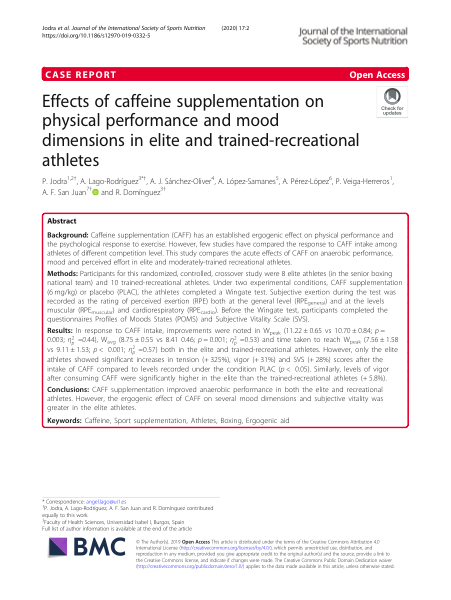
Caffeine supplementation (CAFF) has an established ergogenic effect on physical performance and the psychological response to exercise. However, few studies have compared the response to CAFF intake among athletes of different competition level. This study compares the acute effects of CAFF on anaerobic performance, mood and perceived effort in elite and moderately-trained recreational athletes.
Methods
Participants for this randomized, controlled, crossover study were 8 elite athletes (in the senior boxing national team) and 10 trained-recreational athletes. Under two experimental conditions, CAFF supplementation (6 mg/kg) or placebo (PLAC), the athletes completed a Wingate test. Subjective exertion during the test was recorded as the rating of perceived exertion (RPE) both at the general level (RPEgeneral) and at the levels muscular (RPEmuscular) and cardiorespiratory (RPEcardio). Before the Wingate test, participants completed the questionnaires Profiles of Moods States (POMS) and Subjective Vitality Scale (SVS).
Results
In response to CAFF intake, improvements were noted in Wpeak (11.22 ± 0.65 vs 10.70 ± 0.84; p = 0.003; ηp2
=0.44), Wavg (8.75 ± 0.55 vs 8.41 0.46; p = 0.001; ηp2 =0.53) and time taken to reach Wpeak (7.56 ± 1.58 vs 9.11 ± 1.53; p
Description
Caffeine improves performance and mood in athletes, with greater effects observed in elite athletes.