Abstract
Background
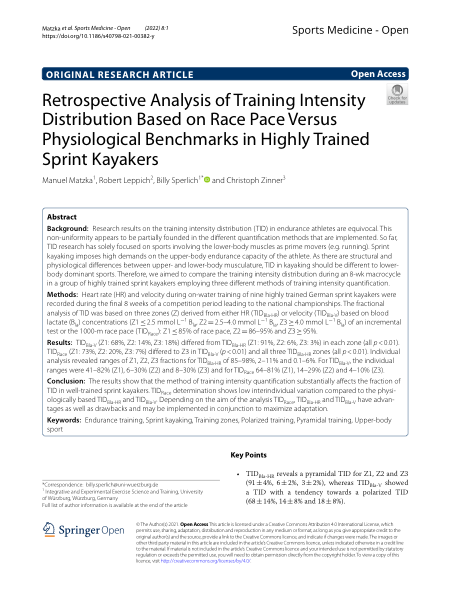
Research results on the training intensity distribution (TID) in endurance athletes are equivocal. This non-uniformity appears to be partially founded in the different quantification methods that are implemented. So far, TID research has solely focused on sports involving the lower-body muscles as prime movers (e.g. running). Sprint kayaking imposes high demands on the upper-body endurance capacity of the athlete. As there are structural and physiological differences between upper- and lower-body musculature, TID in kayaking should be different to lower-body dominant sports. Therefore, we aimed to compare the training intensity distribution during an 8-wk macrocycle in a group of highly trained sprint kayakers employing three different methods of training intensity quantification.
Methods
Heart rate (HR) and velocity during on-water training of nine highly trained German sprint kayakers were recorded during the final 8 weeks of a competition period leading to the national championships. The fractional analysis of TID was based on three zones (Z) derived from either HR (TIDBla-HR) or velocity (TIDBla-V) based on blood lactate (Bla) concentrations (Z1 ≤ 2.5 mmol L−1 Bla, Z2 = 2.5–4.0 mmol L−1 Bla, Z3 ≥ 4.0 mmol L−1 Bla) of an incremental test or the 1000-m race pace (TIDRace): Z1 ≤ 85% of race pace, Z2 = 86–95% and Z3 ≥ 95%.
Results
TIDBla-V (Z1: 68%, Z2: 14%, Z3: 18%) differed from TIDBla-HR (Z1: 91%, Z2: 6%, Z3: 3%) in each zone (all p
Description
This study analyzes training intensity distribution in sprint kayakers.