Abstract
Permissions and Reprints(opens in new window)
Abstract
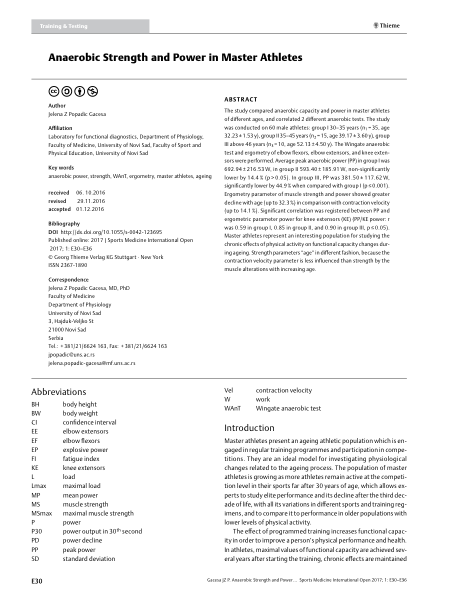
The study compared anaerobic capacity and power in master athletes of different ages,
and correlated 2 different anaerobic tests. The study was conducted on 60 male athletes:
group I 30–35 years (n1=35, age 32.23±1.53 y), group II 35–45 years (n2=15, age 39.17±3.60 y), group III above 46 years (n3=10, age 52.13±4.50 y). The Wingate anaerobic test and ergometry of elbow flexors,
elbow extensors, and knee extensors were performed. Average peak anaerobic power (PP)
in group I was 692.94±216.53 W, in group II 593.40±185.91 W, non-significantly lower
by 14.4% (p>0.05). In group III, PP was 381.50±117.62 W, significantly lower by 44.9%
when compared with group I (p≤0.001). Ergometry parameter of muscle strength and power
showed greater decline with age (up to 32.3%) in comparison with contraction velocity
(up to 14.1%). Significant correlation was registered between PP and ergometric parameter
power for knee extensors (KE) (PP/KE power: r was 0.59 in group I, 0.85 in group II,
and 0.90 in group III, p≤0.05). Master athletes represent an interesting population
for studying the chronic effects of physical activity on functional capacity changes
during ageing. Strength parameters “age” in different fashion, because the contraction
velocity parameter is less influenced than strength by the muscle alterations with
increasing age.
Key words
anaerobic power -
strength -
WAnT -
ergometry -
master athletes -
ageing
Description
The study investigates anaerobic power in master athletes across different age groups.