Abstract
Background
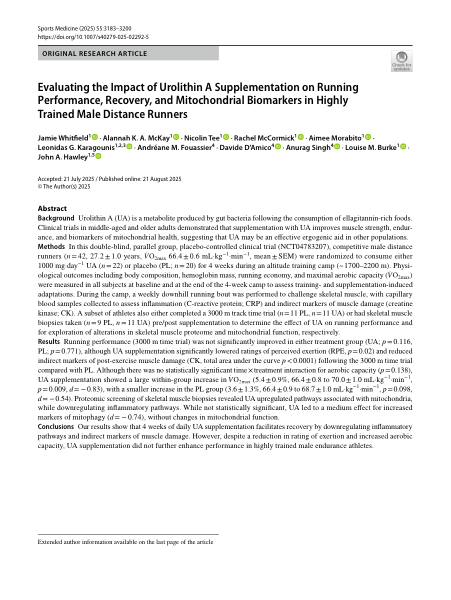
Urolithin A (UA) is a metabolite produced by gut bacteria following the consumption of ellagitannin-rich foods. Clinical trials in middle-aged and older adults demonstrated that supplementation with UA improves muscle strength, endurance, and biomarkers of mitochondrial health, suggesting that UA may be an effective ergogenic aid in other populations.
Methods
In this double-blind, parallel group, placebo-controlled clinical trial (NCT04783207), competitive male distance runners (n = 42, 27.2 ± 1.0 years, \(\dot{V}{\text{O}}_{{{\text{2max}}}}\) 66.4 ± 0.6 mL·kg−1·min−1, mean ± SEM) were randomized to consume either 1000 mg·day−1 UA (n = 22) or placebo (PL; n = 20) for 4 weeks during an altitude training camp (~ 1700–2200 m). Physiological outcomes including body composition, hemoglobin mass, running economy, and maximal aerobic capacity (\(\dot{V}{\text{O}}_{{{\text{2max}}}}\)) were measured in all subjects at baseline and at the end of the 4-week camp to assess training- and supplementation-induced adaptations. During the camp, a weekly downhill running bout was performed to challenge skeletal muscle, with capillary blood samples collected to assess inflammation (C-reactive protein; CRP) and indirect markers of muscle damage (creatine kinase; CK). A subset of athletes also either completed a 3000 m track time trial (n = 11 PL, n = 11 UA) or had skeletal muscle biopsies taken (n = 9 PL, n = 11 UA) pre/post supplementation to determine the effect of UA on running performance and for exploration of alterations in skeletal muscle proteome and mitochondrial function, respectively.
Results
Running performance (3000 m time trial) was not significantly improved in either treatment group (UA; p = 0.116, PL; p = 0.771), although UA supplementation significantly lowered ratings of perceived exertion (RPE, p = 0.02) and reduced indirect markers of post-exercise muscle damage (CK, total area under the curve p
Description
This study evaluates the effects of Urolithin A on performance and recovery in trained male runners.