Abstract
Introduction
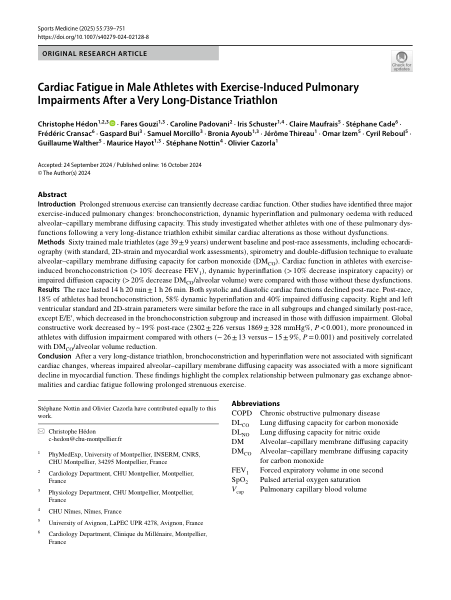
Prolonged strenuous exercise can transiently decrease cardiac function. Other studies have identified three major exercise-induced pulmonary changes: bronchoconstriction, dynamic hyperinflation and pulmonary oedema with reduced alveolar–capillary membrane diffusing capacity. This study investigated whether athletes with one of these pulmonary dysfunctions following a very long-distance triathlon exhibit similar cardiac alterations as those without dysfunctions.
Methods
Sixty trained male triathletes (age 39 ± 9 years) underwent baseline and post-race assessments, including echocardiography (with standard, 2D-strain and myocardial work assessments), spirometry and double-diffusion technique to evaluate alveolar–capillary membrane diffusing capacity for carbon monoxide (DMCO). Cardiac function in athletes with exercise-induced bronchoconstriction (> 10% decrease FEV1), dynamic hyperinflation (> 10% decrease inspiratory capacity) or impaired diffusion capacity (> 20% decrease DMCO/alveolar volume) were compared with those without these dysfunctions.
Results
The race lasted 14 h 20 min ± 1 h 26 min. Both systolic and diastolic cardiac functions declined post-race. Post-race, 18% of athletes had bronchoconstriction, 58% dynamic hyperinflation and 40% impaired diffusing capacity. Right and left ventricular standard and 2D-strain parameters were similar before the race in all subgroups and changed similarly post-race, except E/E′, which decreased in the bronchoconstriction subgroup and increased in those with diffusion impairment. Global constructive work decreased by ~ 19% post-race (2302 ± 226 versus 1869 ± 328 mmHg%, P
Description
The study examines cardiac fatigue in male triathletes post a long-distance triathlon.