Abstract
Background
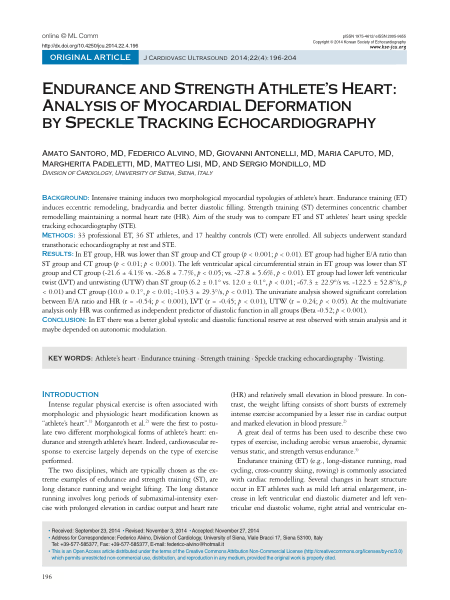
Intensive training induces two morphological myocardial typologies of athlete's heart. Endurance training (ET) induces eccentric remodeling, bradycardia and better diastolic filling. Strength training (ST) determines concentric chamber remodelling maintaining a normal heart rate (HR). Aim of the study was to compare ET and ST athletes' heart using speckle tracking echocardiography (STE).
Methods
33 professional ET, 36 ST athletes, and 17 healthy controls (CT) were enrolled. All subjects underwent standard transthoracic echocardiography at rest and STE.
Results
In ET group, HR was lower than ST group and CT group (p < 0.001; p < 0.01). ET group had higher E/A ratio than ST group and CT group (p < 0.01; p < 0.001). The left ventricular apical circumferential strain in ET group was lower than ST group and CT group (-21.6 ± 4.1% vs. -26.8 ± 7.7%, p < 0.05; vs. -27.8 ± 5.6%, p < 0.01). ET group had lower left ventricular twist (LVT) and untwisting (UTW) than ST group (6.2 ± 0.1° vs. 12.0 ± 0.1°, p < 0.01; -67.3 ± 22.9°/s vs. -122.5 ± 52.8°/s, p < 0.01) and CT group (10.0 ± 0.1°, p < 0.01; -103.3 ± 29.3°/s, p < 0.01). The univariate analysis showed significant correlation between E/A ratio and HR (r = -0.54; p < 0.001), LVT (r = -0.45; p < 0.01), UTW (r = 0.24; p < 0.05). At the multivariate analysis only HR was confirmed as independent predictor of diastolic function in all groups (Beta -0.52; p < 0.001).
Conclusion
In ET there was a better global systolic and diastolic functional reserve at rest observed with strain analysis and it maybe depended on autonomic modulation.
Keywords
Athlete's heart; Endurance training; Strength training; Speckle tracking echocardiography; Twisting
Go to:
Description
The study analyzes myocardial deformation in endurance and strength athletes.