Abstract
Purpose
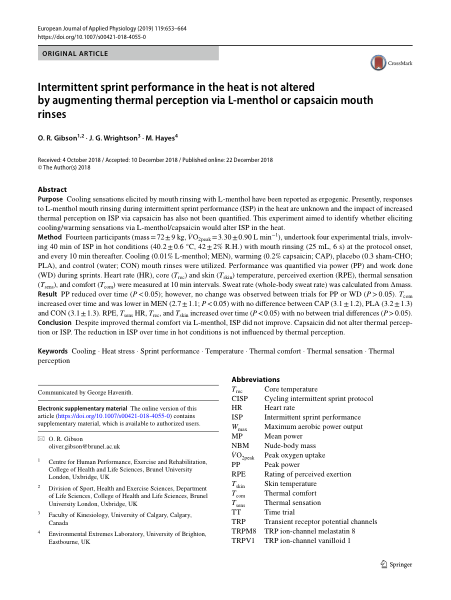
Cooling sensations elicited by mouth rinsing with L-menthol have been reported as ergogenic. Presently, responses to L-menthol mouth rinsing during intermittent sprint performance (ISP) in the heat are unknown and the impact of increased thermal perception on ISP via capsaicin has also not been quantified. This experiment aimed to identify whether eliciting cooling/warming sensations via L-menthol/capsaicin would alter ISP in the heat.
Method
Fourteen participants (mass = 72 ± 9 kg, \(\dot {V}{{\text{O}}_{2{\text{peak}}}}\) = 3.30 ± 0.90 L min−1), undertook four experimental trials, involving 40 min of ISP in hot conditions (40.2 ± 0.6 °C, 42 ± 2% R.H.) with mouth rinsing (25 mL, 6 s) at the protocol onset, and every 10 min thereafter. Cooling (0.01% L-menthol; MEN), warming (0.2% capsaicin; CAP), placebo (0.3 sham-CHO; PLA), and control (water; CON) mouth rinses were utilized. Performance was quantified via power (PP) and work done (WD) during sprints. Heart rate (HR), core (Trec) and skin (Tskin) temperature, perceived exertion (RPE), thermal sensation (Tsens), and comfort (Tcom) were measured at 10 min intervals. Sweat rate (whole-body sweat rate) was calculated from ∆mass.
Result
PP reduced over time (P 0.05). Tcom increased over time and was lower in MEN (2.7 ± 1.1; P
Description
The study investigates the effects of L-menthol and capsaicin on sprint performance in heat.